

Why venue sustainability matters
Sport hospitality brings many guests to one place for a single day. Travel, food, energy and waste all add to the event’s footprint. More companies now ask about these issues before they book. The venue’s own programme therefore matters as much as the package you choose.
ICON runs inside venues that other organisations own and manage. Engage does not set those venues’ policies. It can, however, help you understand what each venue has committed to and how it delivers. This guide sets out what the ICON venues have published, so you know which questions to ask.
The figures below come from venue, partner and accreditation publications. A target is not the same as an achievement. Where a venue has set a goal rather than reached it, the text says so.
Allianz Stadium, Twickenham
Allianz Stadium is the home of England Rugby, and the Rugby Football Union (RFU) owns it. The stadium holds BS 20121 accreditation, which is a standard for managing the sustainability of events. It has also achieved ISO 50001, a standard for energy management.
Waste is a clear strength. The stadium has operated a zero-waste-to-landfill policy for several years. Stadium waste is either recycled or used for energy recovery. On the food side, menus include at least 80% seasonal British fruit and vegetables. Surplus food goes to charities, and food waste is processed through anaerobic digestion to generate electricity and fertiliser. Single-use plastic straws, stirrers and sauce sachets have been removed.
Energy and travel are also part of the picture. Solar panels power the South Stand, where Engage’s ICON facility is located. The stadium recovers excess heat for heating and hot water. More than 100 secure cycle racks and seven electric vehicle charging points support guests who travel in a lower-impact way. The RFU’s redevelopment plans include sustainable materials and energy-efficient systems, although these are still at the planning stage.
Wembley Stadium
Wembley Stadium has been a zero-waste-to-landfill venue since 2010. It was also the first sporting venue to achieve the Carbon Trust Triple Standard, which it gained in 2014. The stadium holds ISO 20121, a standard for event sustainability management.
Recycling rates are high for a venue of this scale. At the 2023 Women’s FA Cup Final, 77% of waste was recycled, and the stadium’s waste partner Veolia helped deliver that result. The venue has also introduced electric and HVO-powered vehicles to clean up after events.
The Football Association (FA) owns Wembley. Its five-year sustainability strategy sets a net zero target for 2040 and includes plans to invest over £35 million to reach it. The FA has also said it has developed a process to recycle the football pitch, which uses a hybrid of grass and plastic. ICON at Wembley hosts international fixtures, NFL matches and concerts in the East Stand, so these event-day practices apply to your guests’ visit.
Lord’s
Marylebone Cricket Club (MCC) owns Lord’s. In 2009, Lord’s became the first UK sports venue to appoint a full-time sustainability manager. In September 2023, MCC launched its Net Zero Carbon Strategy. The club’s targets are net zero for direct and energy emissions by 2030, and net zero across all emissions by 2040.
Heating and cooling are a key part of the work. Ground source heat pumps heat and cool the Warner, Compton and Edrich stands. These stands account for half of the ground’s capacity. Building management systems now run across several stands and buildings. The club has also sourced renewable electricity since 2016.
Waste and pitch management are also in focus. Lord’s produces around 300 to 320 tonnes of waste a year. Between 55% and 57% of this is recycled. No artificial pesticides or fungicides are used on the pitch. MCC states that Lord’s was the first cricket ground to publish a full organisational carbon footprint, including all Scope 3 categories. In 2026, MCC also partnered with ExpectAI to manage emissions across its supplier chain.
The Kia Oval
Surrey County Cricket Club and The Kia Oval have pledged to reach net zero by 2030. They aim to cut the emissions of the club and the venue by 80%. The club has also signed the Net Zero Carbon Pledge for the Events Industry. It has appointed a Head of Sustainability to lead the work.
Energy is a strong area. All electricity at the venue comes from renewable sources. Solar panels sit on the roofs of several stands, including the JM Finn Stand, which houses the ICON facility. The club has also commissioned an energy audit with its energy partner, SSE Energy Solutions, to explore further solar options.
Waste and food are managed carefully. The venue uses five waste streams to keep general waste to a minimum. Food packaging is compostable, and there is no single-use plastic in the food and drink outlets. Food waste is processed on site and through anaerobic digesters. The club reports that at least 40% of its menus are plant-forward and that at least 80% of ingredients are British-grown, which is a target rather than a confirmed figure.
Emirates Old Trafford
Lancashire Cricket set up a sustainability working group at the end of the 2022 season. The club’s stated goal is to become a fully net zero venue. Its current work includes removing single-use plastic, reducing energy use, improving recycling and buying renewable electricity.
In 2026, Lancashire Cricket signed a three-year partnership with the energy supplier Utilita. Under the agreement, more than 1,000 solar panels will go on key buildings at the ground. The installation is expected to generate around 400,000 kWh of clean electricity a year. It should also cut more than 80 tonnes of carbon emissions each year. These figures are projections, so the actual output will depend on the installation.
The ground has also partnered with the local charity City of Trees, which has planted trees and hedges around the site. On matchdays, catering includes halal, vegan and vegetarian options. ICON sits within The Point, with an elevated viewing balcony.

Engage’s Event Calendar
Silverstone
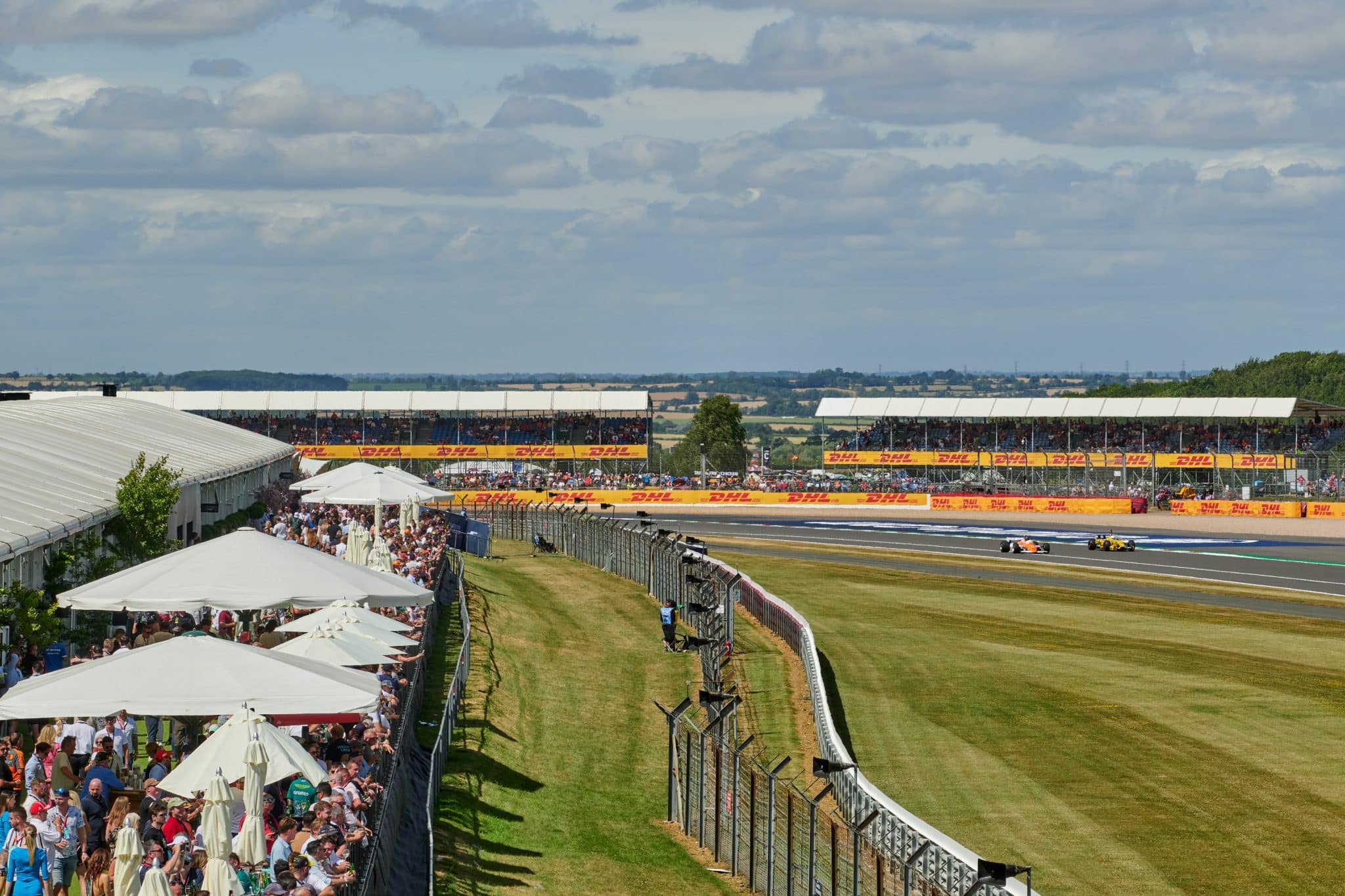
Silverstone launched its Shift to Zero strategy in 2022. The circuit has committed to reduce its carbon emissions by 50% by 2030 and to reach net zero by 2040. This supports Formula 1’s goal of net zero by 2030. Silverstone was also the first motor racing venue to join the UN’s Sports for Climate Action framework.
Energy is central to the plan. Silverstone has installed 2,764 solar panels on The Wing, which the circuit says generate 18% of its annual electricity demand. The venue reports that it uses renewable electricity and HVO biofuel in its generators. It has also installed electric vehicle charging points and switched around half of its lighting to LEDs.
Silverstone holds several recognised accreditations. These include ISO 14001 for environmental management, FIA 3-star environmental accreditation and ISO 20121 for sustainable events. The circuit reported a 44% business-wide recycling rate in 2025, and it has set a goal of zero food waste. In 2025, Silverstone also became a signatory to the Sport for Nature Framework, which focuses on protecting nature.
Cheltenham
Cheltenham Racecourse is part of The Jockey Club group. The group has signed up to the UN Sport for Climate Action framework. It aims to cut emissions by 50% by 2030 and reach net zero by 2040. As an interim step, the Jockey Club has committed to becoming carbon neutral by 2027.
Waste and energy are both areas of progress. The Jockey Club says it has sent no waste to landfill since 2018. Solar panels at Cheltenham generated enough electricity in 2019 to power 18 homes. That figure rose to 57 homes when the group’s panels across all racecourses were counted. The group has said it aims to reach net zero across its catering operations by 2027.
Food at the Festival is also a focus. Reports indicate that the catering team sources produce from within 60 miles of the racecourse. Many dishes are served on tableware made in the racecourse’s own carpentry workshop. For the 2026 Festival, the racecourse capped daily attendance at 66,000, expanded family zones and added electric shuttle services. Reports also describe greater use of renewable energy at the event.
Henley Royal Regatta
Henley Royal Regatta has restricted single-use plastic across its event grounds. It promotes reusable cups, glassware and compostable packaging instead. Athletes also have access to refillable water stations.
Waste is managed with the waste company Grundon. The regatta reports that its waste is recycled, composted or used for energy recovery. Each year, volunteers join a paddleboard clean-up of the river as part of Plastic Free July. The fourth annual clean-up took place in 2025, led by the regatta with the group Warriors on Waste.
For 2026, the official hospitality partner, Sodexo Live, has set out a more sustainable approach to food. The menus draw on producers from across the Thames Valley to reduce food miles. The partner has also committed to cutting single-use plastics and managing surplus food in a more structured way.
Ascot
Ascot Racecourse published its Racing to Zero strategy in 2022. It aims to reach net zero by 2040. The racecourse has been a signatory to the UN Sports for Climate Action framework since 2022. In 2024, it became the first racecourse in the world to receive ECOsmart accreditation, which the environmental consultancy Greengage awarded at Silver level.
Energy use is changing across the course. Ascot reports that it has used 100% renewable energy since October 2019. A new building management system cut lighting energy use by 70%. The racecourse has installed solar technology, including a SmartFlower array and a major rooftop solar installation on its grandstand roof.
Royal Ascot shows how the work applies to events. In 2023, the Village Enclosure operated as a net zero area for the Royal Meeting. Ascot said it offset the residual emissions through certified programmes. The racecourse also reports zero waste to landfill, closed-loop recycling and electric waste collection vehicles. Biodiversity projects include beehives and wildflower meadows. Ascot won the Racing Foundation Green Award for 2023.
The Grove
The Grove is a five-star hotel with a championship golf course, and ICON golf days take place there. The hotel reports a zero-landfill policy. A waste partner case study says the hotel cut its general waste substantially after introducing a new strategy.
The golf course holds GEO Certified status, which the GEO Foundation awards for sustainable golf course operation. The club uses organic fertilisers and reduces managed turf to lower its use of water, fuel and chemicals. A wetland regeneration project supports local wildlife on the estate. The hotel also grows produce in a kitchen garden for its restaurants.
Buildings and energy are part of the approach too. The hotel uses solar panels and energy-efficient LED lighting. Its fact sheet reports a Green Apple Award silver for environmental best practice. The Grove’s own sustainability statement sets out further details, which we recommend checking before publication.
What this means for your booking
Venue sustainability is only part of the picture. Travel to the venue can also make up a large share of an event’s total footprint. Before you book, ask each venue how guests can travel well. Rail, shuttle buses, cycling and electric vehicle charging all help.
Ask about the venue’s waste and catering practices too. Recycling rates, food sourcing and single-use plastic policies are all useful to compare. You may find that one venue suits a sustainability-focused brief better than another.
Carbon offsets have a role, but they do not replace cutting emissions. Venues that combine clear targets with measured progress give you the strongest starting point. Our team can answer detailed questions about a specific ICON venue and event.