
Upcoming Races: Mexican Grand Prix™ | Brazilian Grand Prix™ | Las Vegas Grand Prix™ | Abu Dhabi Grand Prix™
Race Round-Up: Formula 1 MSC Cruises United States Grand Prix 2026
Kimi Antonelli took pole with what Toto Wolff called a miracle lap, then controlled the United States Grand Prix from the front on a one-stop strategy nobody else made work. He did not quite clinch the championship in Austin, because Lewis Hamilton and George Russell both finished too high, but he arrives in Mexico City needing only a ninth-place finish to become Formula 1’s youngest ever world champion. Behind him, the fight for second has compressed to a single point.
Qualifying: A Miracle Lap in Austin
Nothing about Saturday suggested a Mercedes pole. After all, Ferrari had topped all three practice sessions, Red Bull looked quick when it mattered, and Antonelli had finished fourth in final practice, three tenths off Hamilton.
Then Norris led Q1, Leclerc topped Q2, and Antonelli produced a 1:34.035 on his first run in Q3 that nobody could touch. He abandoned his second lap because there was no point in improving it. The margin over Verstappen was 0.179 seconds, with Hadjar a further 0.036 behind in third, and it was Antonelli’s seventh pole of the season and his first since Belgium.
Leclerc and Hamilton lined up fourth and fifth, Russell sixth, Piastri seventh. Crucially, the significance was immediate: Antonelli could win the title on Sunday only if he won the race, Russell finished ninth or lower and Hamilton finished outside the top four. With both British drivers starting in the top six, that always looked a stretch.
Meanwhile, grid penalties shuffled the back of the field. Arvid Lindblad dropped to fourteenth, and Franco Colapinto and Gabriel Bortoleto fell to twentieth and twenty-first, all three having exceeded power unit allocations. Lance Stroll started from the pit lane after parc fermé modifications.
Race Day at the Circuit of the Americas
A Clean Getaway and a Red Bull Stumble
Antonelli launched well and held the lead up the hill to Turn 1. Verstappen, by contrast, did not, appearing to suffer a deployment problem that dropped him into the clutches of both Ferraris. Leclerc took second with a confident move and Hamilton went side by side before settling for fourth, though Verstappen had recovered the position before the opening lap was out.
A brief Virtual Safety Car to clear debris came and went without denting Antonelli’s advantage, and by lap 10 he led by nearly three seconds.
Russell’s afternoon then took a turn. Stewards investigated him for leaving the track and gaining an advantage after banging wheels with Piastri, and handed down a five-second penalty. His response over the radio was unambiguous: he had been on the inside, Piastri had chosen to go round the outside, and that was the Australian’s risk to take. Nevertheless, the penalty stood.
The One-Stop Nobody Else Tried
This is where Antonelli won the race. Ferrari and McLaren both committed early to two stops, pitting Hamilton on lap 14 and Leclerc and the McLarens shortly after. Mercedes, by contrast, went the other way, extending Antonelli’s first stint on the mediums while his engineer told him to go as long as he could.
Red Bull, meanwhile, were unravelling. Red Bull told Hadjar to let Verstappen past, which he did after some initial resistance, although both cars then developed problems. Incorrect mapping left Hadjar fighting his throttle. Verstappen described his car as undriveable and, when his team asked for an update on his front wing, replied that he had literally no idea.
Antonelli finally stopped at the end of lap 24 for hards and rejoined fourth, then picked his way back to the front as the two-stoppers came in for a second time. Indeed, Oliver Bearman’s day summed up the midfield: a ten-second penalty while running eighteenth, an incredulous radio message, and eventual retirement with damage.
Leclerc Wins the Scrap, Antonelli Wins the Race
With twenty laps left Antonelli led from Leclerc and Hamilton, and the only genuine drama came behind him. McLaren gambled on leaving Norris out on worn hards in the hope of a podium. Verstappen caught and passed him at the start of lap 47, Leclerc came through next despite a lock-up, and Hamilton followed. Norris dropped from a podium position to fifth in the space of a few laps.
Leclerc was not finished. Late on he took second from Verstappen, possibly because the Red Bull was struggling with engine braking, to claim a second consecutive runner-up finish.
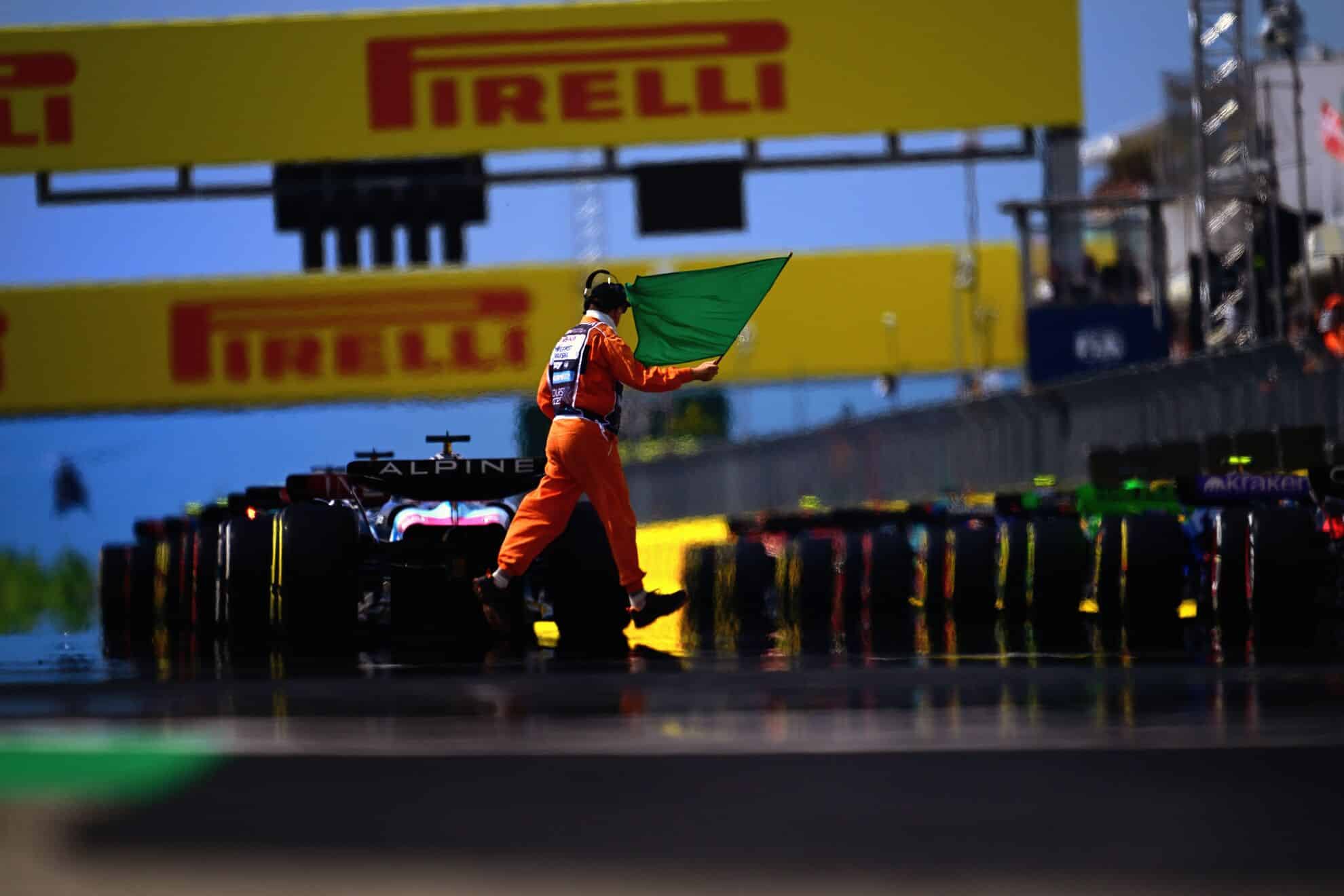
Valtteri Bottas stopped at the side of the track to bring out a late Virtual Safety Car, but Antonelli’s margin was comfortable enough that it changed nothing. Ultimately he took the flag 13.078 seconds clear for his ninth win of the season.
How They Finished
Antonelli won from Leclerc and Verstappen, the Dutchman’s sixth consecutive podium. Hamilton took fourth and Norris fifth, with Hadjar sixth and Piastri seventh. Russell could only manage eighth after his penalty, with Liam Lawson ninth and Pierre Gasly taking the final point.
Nico Hulkenberg, Lindblad and Bortoleto filled eleventh to thirteenth, the Brazilian recovering well from a remarkable eighty-place grid penalty. Esteban Ocon was fourteenth as Haas failed to score at their home race, ahead of the Aston Martins of Stroll and Fernando Alonso.
Williams extended a pointless run to three events with Alex Albon and Carlos Sainz ahead of Sergio Perez. Colapinto, Bearman and Bottas all retired.
Formula 1 2026 Season
Five rounds remain, a maiden world championship could be settled in Mexico City, and four drivers are covered by thirty points in the fight for second. Engage Hospitality is an Official Formula 1® Paddock Club™ Authorised Distributor, with premium access across the closing stretch of the calendar.
F1 standings for 2026
| Position | Driver | Team | Wins | Podiums | Points |
| 1 | Kimi Antonelli | Mercedes | 9 | 15 | 365 |
| 2 | George Russell | Mercedes | 3 | 8 | 242 |
| 3 | Lewis Hamilton | Ferrari | 1 | 6 | 241 |
| 4 | Max Verstappen | Red Bull | 2 | 10 | 236 |
| 5 | Charles Leclerc | Ferrari | 1 | 6 | 233 |
| 6 | Lando Norris | McLaren | 2 | 5 | 211 |
| 7 | Oscar Piastri | McLaren | 0 | 2 | 144 |
| 8 | Isack Hadjar | Red Bull | 0 | 2 | 105 |
| 9 | Liam Lawson | Racing Bulls | 0 | 0 | 77 |
| 10 | Pierre Gasly | Alpine | 0 | 0 | 42 |
Antonelli leads by 123 points with 125 still available. Russell, Hamilton, Verstappen and Leclerc are separated by just nine points in the fight for second.
Paddock Gossip
One Ninth Place From History
Antonelli needs a ninth-place finish in Mexico City to be certain of the championship, and realistically far less than that. He is a maximum of two points away from the title being mathematically settled, which means almost any ordinary Sunday will do it.
Afterwards, Wolff described the pole lap as a miracle and later called the race Antonelli’s best to date, which from a team principal who has been notably willing to criticise his young driver this season is worth noting. Antonelli himself was careful afterwards, saying the result was the one they needed and crediting the strategy call, before admitting he hopes to settle the championship very soon.
If he does it on Sunday, he becomes Formula 1’s youngest ever world champion at twenty.
Everything That Could Go Wrong for Red Bull
Admittedly, third and sixth looks respectable on paper. The reality was a weekend of accumulating problems.
Verstappen lost the start to what appeared to be a deployment issue, spent the middle of the race describing an undriveable car, had no clear idea what his front wing was doing, and seemed to be managing engine braking trouble by the time Leclerc took second from him. Hadjar spent a stint on incorrect mapping that affected his throttle, and then had to move aside for his teammate.
That it still produced a sixth consecutive podium for Verstappen says something about the current state of the Red Bull. Whether it is enough to win the fight for second is another question entirely.
McLaren Admit They Are Off the Pace
Norris was blunt before the weekend even started, saying McLaren are simply not quick enough, and Sunday did little to contradict him. The decision to leave him out on ageing hard tyres in pursuit of a podium backfired completely, and he lost three places in the closing laps to drivers on fresher rubber.
As a result, the reigning champions are now sixth and seventh in the drivers’ standings. For a team that arrived in 2026 as the benchmark, that is a considerable fall, and the conversation has already shifted to what next season’s car needs to be.
Russell’s Penalty and a One-Point Cushion
The five-second penalty for the incident with Piastri cost Russell time he could not afford, and eighth place leaves him just one point ahead of Hamilton in the fight for second overall. Verstappen is six behind that, Leclerc nine.
Russell’s argument that a driver going round the outside accepts the risk is one most of the grid would make. The stewards disagreed, and with four drivers covered by nine points over five rounds, decisions of that size are going to matter.
Eighty Places
Worth recording for the statisticians. Bortoleto took an eighty-place grid penalty for Audi after exhausting his power unit allocation, which on a twenty-two car grid is a figure with no practical meaning beyond starting last. He recovered to thirteenth, which was the best anyone was going to do from there.
Mexico City Grand Prix Preview
Formula 1 moves straight on to Mexico City, where Kimi Antonelli will almost certainly settle the championship.
The Layout
Turn 1 is the obvious answer, and the altitude makes it more so. Thin air means less drag, which means enormous slipstream effects down that long opening straight and cars arriving three abreast with regularity. It also means braking distances stretch out, because there is far less aerodynamic drag helping to slow the car, so late moves either stick spectacularly or end in the run-off.
In addition, Turn 4 offers a second opportunity for anyone who has lost out at the first complex, and the stadium section occasionally produces something at Turn 12. The midfield tends to make most of its progress on lap one here, which is part of why the race so often looks chaotic in its opening minutes.
Where the Overtaking Should Happen
Turn 1 is the obvious answer, and the altitude makes it more so. Thin air means less drag, which means enormous slipstream effects down that long opening straight and cars arriving three abreast with regularity. It also means braking distances stretch out, because there is far less aerodynamic drag helping to slow the car, so late moves either stick spectacularly or end in the run-off.
In addition, Turn 4 offers a second opportunity for anyone who has lost out at the first complex, and the stadium section occasionally produces something at Turn 12. The midfield tends to make most of its progress on lap one here, which is part of why the race so often looks chaotic in its opening minutes.
How It Compares to Marina Bay
Both are permanent circuits with long straights and heavy braking zones, and both reward a car that can follow closely. The similarity ends with the air.
Teams arrive in Mexico City running maximum-downforce rear wings, the sort they would otherwise save for Monaco, and those wings produce roughly what a low-downforce Monza setup would generate at sea level. Similarly, cooling becomes marginal, with teams opening up bodywork in ways they would never consider at Austin. Turbochargers work substantially harder to compress thin air, and brake cooling is a genuine limitation rather than a box to tick.
The practical consequence is that Mexico tends to reorder the competitive picture. A car that works well at Austin will not necessarily work here, and teams that have nailed their cooling package historically do better than raw pace alone would suggest.
The other difference is the crowd. Austin is a festival with a race in the middle. Mexico City regularly posts attendances above 400,000 across the weekend, among the largest on the calendar, and the stadium section gives it an atmosphere closer to a football match than a Grand Prix.
What a Title Decider Means for Hospitality Demand
The scarcity argument that applied to Austin applies here with more force, because this time the championship will probably end on Sunday rather than merely being able to. Moreover, a title decider is the rarest event on the calendar, and nobody can book one in advance.
Mexico City has its own draw regardless. Race day falls on 1 November, Día de Muertos, which means the weekend coincides with one of the most significant dates in the Mexican calendar and a city in full celebration. For a client trip, few Grands Prix offer that much beyond the circuit itself.
There is also a practical point worth making to anyone weighing the remaining calendar. With Mexico City, São Paulo, Las Vegas, Qatar and Abu Dhabi left, the window for securing anything at the closing races is now narrow, and the finale in Abu Dhabi tends to sell earliest of all.
Mexican Grand Prix hospitality | F1® Paddock Club™ packages
After Mexico
São Paulo follows a week later from 6 to 8 November at Interlagos, historically one of the best races of the year. Las Vegas runs from 19 to 21 November, Qatar from 27 to 29 November, and the season closes at Yas Marina from 4 to 6 December.
Brazilian Grand Prix hospitality | Abu Dhabi Grand Prix hospitality
Frequently Asked Questions
Who won the 2026 United States Grand Prix?
Kimi Antonelli won at the Circuit of the Americas for Mercedes, converting pole position into his ninth victory of the season and finishing 13.078 seconds ahead of Charles Leclerc, with Max Verstappen third.
Did Kimi Antonelli win the championship in Austin?
No. Antonelli needed to win while George Russell finished ninth or lower and Lewis Hamilton finished outside the top four. Russell came eighth and Hamilton fourth, so the championship stays open.
What does Antonelli need to win the title in Mexico?
A ninth-place finish or better at the Mexico City Grand Prix guarantees the championship. In practice he is a maximum of two points away from mathematical certainty.
Why is the Mexico City Grand Prix so different from other races?
The Autódromo Hermanos Rodríguez sits at roughly 2,240 metres above sea level, the highest on the calendar. The thin air reduces downforce and cooling dramatically, so teams run maximum-downforce wings that behave like low-downforce setups elsewhere.
Where can I book Formula 1 hospitality for Mexico City?
Engage Hospitality is an Official Formula 1® Paddock Club™ Authorised Distributor and offers hospitality packages for the Mexico City Grand Prix, alongside São Paulo, Las Vegas, Qatar and the Abu Dhabi finale.
Experience Formula 1 with Engage
A twenty-year-old is about to become the youngest world champion in the sport’s history, and the fight for second place behind him runs to within nine points across four drivers. There are five rounds left to see it.
Engage Hospitality is an Official Formula 1® Paddock Club™ Authorised Distributor, offering premium access at races across the calendar. Whether you are hosting clients in the stadium section at Mexico City, entertaining at Interlagos, or planning the Abu Dhabi finale, our team can build the package around you.