



The History of Wimbledon: From a Croquet Lawn to the World’s Greatest Grand Slam

Wimbledon is the oldest tennis tournament in the world, and almost 150 years after the first ball was struck it remains the sport’s most recognisable stage. What began as a fundraising idea by a struggling croquet club has grown into a fortnight that stops the British summer, fills the grounds at SW19 and reaches hundreds of millions of viewers worldwide. This guide traces the full story: the founding of the All England Club, the first Championships in 1877, the move to Church Road, the arrival of the Open era, the great rivalries, and the modern innovations that have reshaped how the tournament is played and watched. At the end, we look at how Wimbledon debentures fit into that history and how Engage can secure them for The Championships, Wimbledon 2027.
A croquet club in need of a pony roller
The story starts not with tennis but with croquet. The All England Croquet Club was founded in July 1868, at the peak of a Victorian craze for the game, on four acres of leased meadowland off Worple Road in Wimbledon, between the village and the railway line.
Croquet’s popularity did not last. By the mid-1870s the club was struggling, and in 1875 it set aside one of its lawns for a new pastime that had been codified only a year or two earlier by Major Walter Clopton Wingfield. He had originally given it the unwieldy name “sphairistike”. The rest of the world came to call it lawn tennis.
The new game proved far more popular than croquet, and in April 1877 the club renamed itself the All England Croquet and Lawn Tennis Club. It also needed money. The immediate problem was a broken pony-drawn roller used to maintain the lawns, and the solution was to stage a tennis tournament and charge for entry. That decision, taken to cover the cost of a piece of groundskeeping equipment, created the Championships.
Wimbledon Debentures 2027
The first Championships, 1877
The inaugural Lawn Tennis Championship opened on 9 July 1877 at Worple Road. Entry was advertised in the sporting magazine The Field, and 22 men paid one guinea each to compete. Only one event was held, the Gentlemen’s Singles, and it was open exclusively to amateurs.
Rain, a theme that would recur for the next 130 years, delayed the final by three days. When it was finally played on 19 July, roughly 200 spectators paid a shilling each to watch Spencer Gore, a 27-year-old rackets player and Surrey cricketer, beat William Marshall 6-1, 6-2, 6-4 in about 48 minutes. Gore’s tactic was to rush the net and volley, a style that some observers of the day considered faintly unsporting. He collected a silver challenge cup valued at 25 guineas and became the first name on a list that now includes almost every great of the sport.
A quirk of those early years was the challenge round, introduced in 1878. The defending champion sat out the tournament entirely and played only the winner of the All Comers’ event to decide the title. That advantage lasted until 1922.
Growing the tournament: 1884 to 1913
Women’s tennis arrived at Wimbledon in 1884, when the Ladies’ Singles was staged alongside a new Gentlemen’s Doubles competition. Thirteen women entered, and Maud Watson became the first ladies’ champion. Ladies’ Doubles and Mixed Doubles followed as full championship events in 1913, completing the five main draws still contested today.
The tournament’s reach widened quickly. May Sutton became the first overseas champion in 1905, and by then the club’s title had settled into its familiar form, having been changed to the All England Lawn Tennis and Croquet Club in 1899. What had started as a local amateur competition was, within three decades, an international occasion.
The move to Church Road in 1922
By 1919 the Championships had outgrown Worple Road. Demand for tickets far exceeded what four acres could accommodate, and the club needed a new home.
The funding mechanism it chose has become part of Wimbledon folklore. In 1920 the All England Club issued its first debentures, raising £100,000 from around 2,000 buyers who each committed £50 for a 25-year instrument. That money helped purchase the Church Road site and build a new stadium: Centre Court.
The relocated Championships opened in 1922, with Gerald Patterson and Suzanne Lenglen taking the singles titles. The same year the challenge round was abolished, meaning defending champions had to play through the draw like everyone else. The original Worple Road ground is now part of Wimbledon High School’s playing fields.
Two world wars and a bombed Centre Court
The Championships were not held during the First World War, from 1915 to 1918, nor during the Second, from 1940 to 1945. Those interruptions remain, along with the cancellation of 2020, the only years since 1877 in which no champions were crowned.
Wimbledon did not escape the war unscathed. In October 1940 a bomb struck Centre Court, destroying around 1,200 seats. The tournament returned in 1946 with the damage still visible, and full repairs were not completed until 1949. Television, meanwhile, had already arrived: the BBC broadcast from Wimbledon for the first time in 1937.
The Open era arrives in 1968
For its first 91 years, Wimbledon was strictly amateur. Champions received trophies and prestige but no prize money, while the best players in the world increasingly turned professional and were barred from competing.
That ended in 1968. Tennis went “open”, professionals were admitted to the Grand Slams, and Wimbledon paid prize money for the first time: a total fund of £26,150, with Rod Laver earning £2,000 as men’s champion and Billie Jean King £750 as ladies’ champion. The disparity in those two figures would take another 39 years to resolve.
The Open era transformed the standard of the draw overnight and set Wimbledon on the path to becoming the commercial institution it is today. To put the change in perspective, the 2026 singles champions each received £3.6 million.
The rivalries that built the legend
Much of Wimbledon’s mystique comes from a handful of matches that transcended the sport.
Djokovic’s era. Novak Djokovic won seven titles at SW19 and, at the 2026 Championships, passed Federer’s record for most Wimbledon men’s singles match wins, reaching 108.
Borg v McEnroe, 1980. Björn Borg won his fifth consecutive title, but the match is remembered for a fourth-set tie-break that McEnroe took 18-16 after saving five championship points. Borg still won in five.
Navratilova’s dominance. Martina Navratilova won nine ladies’ singles titles between 1978 and 1990, a record that stands to this day.
The Sampras years. Pete Sampras claimed seven titles in eight years during the 1990s, on grass that was significantly faster than the surface players face now.
Federer v Nadal, 2008. Widely regarded as the greatest match ever played, decided 9-7 in the fifth as darkness fell. Roger Federer would go on to hold the men’s record of eight singles titles.
Isner v Mahut, 2010. John Isner beat Nicolas Mahut 70-68 in the final set of a first-round match that lasted 11 hours and five minutes across three days, and which prompted a long rethink of final-set rules.
Murray ends the wait, 2013. Andy Murray became the first British men’s singles champion since Fred Perry in 1936, ending a 77-year drought. He won again in 2016.
The modern era: equal pay, roofs and technology
The last two decades have brought more change to Wimbledon than any period since the move to Church Road.
Equal prize money, 2007. Wimbledon became the last Grand Slam to pay men and women equally, following the US Open in 1973, the Australian Open in 2001 and the French Open in 2006. Roger Federer and Venus Williams were the first champions to receive identical cheques.
The Centre Court roof, 2009. After more than a century of rain delays, a retractable roof was installed over Centre Court, allowing play to continue in poor weather and finals to finish on schedule.
No.1 Court rebuilt and covered. A new No.1 Court opened in 1997, and a roof was added in 2019, taking the number of covered seats across the two show courts to around 26,500.
The cancellation of 2020. For the first time since the Second World War, the Championships were called off. The All England Club had held pandemic insurance since the early 2000s, a decision that proved unusually prescient and reportedly resulted in a payout of well over £100 million.
Middle Sunday, 2022. The traditional rest day was abolished and the Championships moved to a full 14 days of play.
Electronic line calling, 2025. After 148 years, line judges were removed from every court and replaced by automated electronic line calling. The distinctive uniforms disappeared, and with them the challenge system.
Video review, 2026. Wimbledon became the third Grand Slam, after the US Open and Australian Open, to adopt video review. Players can ask the chair umpire to review judgement calls such as a not-up, a foul shot or a touch, on Centre Court, No.1 Court and four other show courts. Reviews are unlimited, but line calls themselves remain uncontestable. Visual indicators were also added to scoreboards so spectators can see “out” and “fault” calls as they happen.
Wimbledon today and what comes next
The 2026 Championships, held from 29 June to 12 July, offered a snapshot of the tournament’s scale. The prize fund reached a record £64.2 million, a 20 per cent increase on 2025 and the largest single-year rise in Wimbledon’s history, with each singles champion earning £3.6 million and first-round losers guaranteed £80,000.
On court, Jannik Sinner defended his men’s title, beating Alexander Zverev 6-7(7), 7-6(2), 6-3, 6-4 to become the tenth man in the Open era to retain the trophy. Linda Nosková won her first Grand Slam, defeating fellow Czech Karolína Muchová 6-2, 5-7, 6-3 in an all-Czech final. British wildcard Arthur Fery reached the semi-finals, and Novak Djokovic set his new match-wins record. Full detail is in our Wimbledon 2026 review.
The bigger story, though, is off court. The All England Club has proposed a roughly £200 million expansion into the former Wimbledon Park Golf Club, which it bought in 2018. The plans would add 39 courts, including an 8,000-seat show court, allowing qualifying to be staged on site rather than at Roehampton, and would almost treble the size of the grounds.
Planning permission was granted by the Greater London Authority in September 2024 and upheld by the High Court in July 2025. Campaign group Save Wimbledon Park was subsequently granted permission to take that decision to the Court of Appeal, and a separate High Court ruling in March 2026, which found the land was not subject to a statutory public recreation trust, has also been cleared for appeal. Both challenges were still outstanding at the time of writing. If the project ultimately proceeds, the club expects the development to be ready in the early 2030s.
Frequently asked questions
When did Wimbledon start? The first Wimbledon Championships began on 9 July 1877 at the All England Croquet and Lawn Tennis Club on Worple Road. Only the Gentlemen’s Singles was contested, with 22 entrants, and Spencer Gore won the title.
Why is Wimbledon called Wimbledon? The tournament takes its name from the south-west London district where the All England Club was founded in 1868 and where it has been based ever since, moving from Worple Road to Church Road in 1922.
Who has won the most Wimbledon titles? Roger Federer holds the men’s singles record with eight titles. Martina Navratilova holds the women’s singles record with nine.
Why is Wimbledon played on grass? Grass was the original surface of lawn tennis, and Wimbledon is the only Grand Slam that still uses it. The Australian Open and US Open both moved to hard courts, and the French Open is played on clay.
Why do Wimbledon players wear white? The all-white dress code originates in Victorian etiquette, when visible sweat marks were considered unacceptable. The rule has been retained as a defining tradition, with a minor relaxation from 2023 allowing women to wear dark undershorts.
Has Wimbledon ever been cancelled? Yes, on three occasions. The Championships were not held during the First World War from 1915 to 1918, during the Second World War from 1940 to 1945, or in 2020 because of the COVID-19 pandemic.
When was the Centre Court roof built? The retractable roof over Centre Court was completed and first used in 2009. No.1 Court received its own roof in 2019.
When is Wimbledon 2027? The Championships, Wimbledon 2027 take place from Monday 28 June to Sunday 11 July 2027.
Wimbledon debentures with Engage
Debentures are not a modern add-on to Wimbledon. They are part of how the tournament was built. The 1920 issue funded the purchase of the Church Road site and the construction of Centre Court, and every subsequent series has helped pay for improvements to the Grounds, including the roofs that now cover the two show courts.
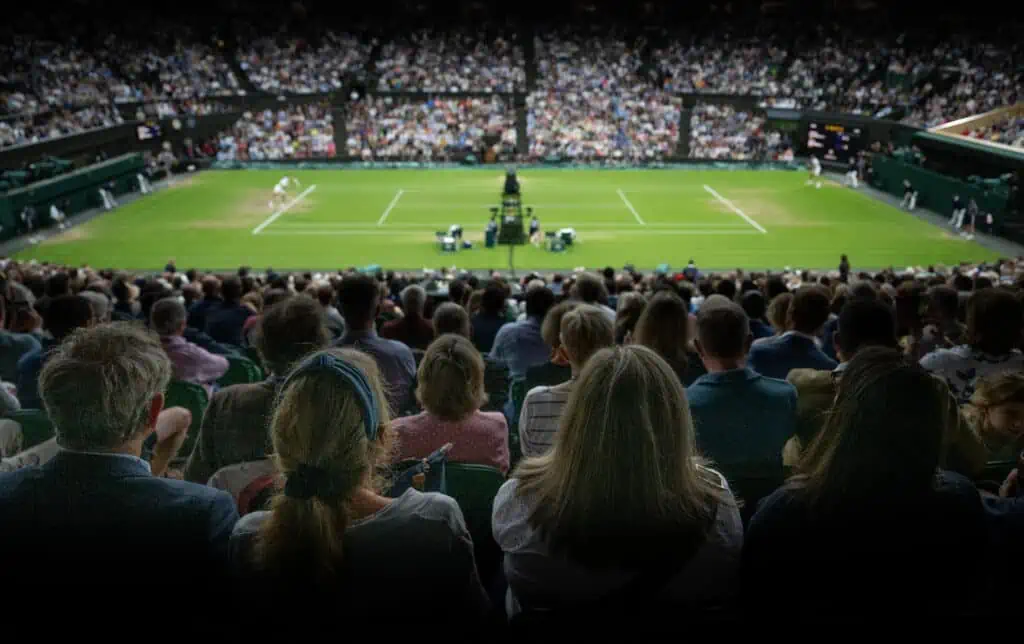
The structure has remained recognisable for more than a century. A debenture is a five-year financial instrument issued by the All England Club that entitles the holder to one premium seat for every day of the Championships across that term, together with access to the exclusive debenture restaurants, bars and lounges. Scarcity is built in: there are 2,520 Centre Court debentures and 1,250 for No.1 Court. Crucially, debenture tickets are the only Wimbledon tickets that can legally be transferred or resold, which is why they reach the market at all.
That is where Engage comes in. We buy debenture tickets from registered holders and make individual days available to private and corporate clients, so you do not need to own a debenture to sit in one of these seats. Since 2020 we have sold more than 1,500 debentures across the Championships, with over 25 per cent of those customers travelling from the United States and elsewhere overseas.
For The Championships, Wimbledon 2027, running from 28 June to 11 July, we can offer:
- Centre Court seating between rows A-N, on the same level as the Royal Box, for every round from the first round through to the Men’s Final
- No.1 Court seating between rows A-Q for rounds one to four and the quarter-finals
- Access to the premium debenture lounges, bars and restaurants throughout your day, with no fixed dining schedule
- A dedicated concierge service and support in choosing the right day and court for your group
Availability is finite and moves quickly, particularly for the second week. If you would like to discuss which day suits your guests, enquire about Wimbledon 2027 debentures or contact the team directly.
The oldest tournament, still setting the standard
Very little about the Championships was inevitable. A croquet club that nearly folded, a tournament staged to buy a roller, a debenture issue that paid for a stadium, and a century and a half of decisions about what to keep and what to change. The result is a fortnight that manages to feel both entirely modern and entirely unchanged, where automated line calling and video review sit alongside white clothing, strawberries and a queue in the park.
That balance is the reason Wimbledon still matters, and the reason a seat on Centre Court remains one of the hardest tickets in sport to find.
Related posts
 All Posts


Follow us
Follow us on social for the latest new and event updates

