US Open Round-Up: What’s Next for Tennis?

The 2026 US Open finished on Sunday night at Flushing Meadows, and it closed a season that has been anything but predictable.

Alexander Zverev and Elena Rybakina go home with the singles titles. Both beat the player most people expected to beat them. Here is how New York played out, and where tennis goes from here.

Zverev completes the job

Zverev beat Ben Shelton 6-3, 7-6(2), 5-7, 6-2 in the men’s final to take his second major title of the season, having won the French Open earlier in the year and reached the final at Wimbledon.

For a player who spent most of a decade being described as the best without a Grand Slam, 2026 has rewritten the story. He arrived in New York as the top seed for the first time at a major and left with the trophy.

The final itself was controlled rather than dramatic. Shelton took the third set and gave the Arthur Ashe crowd something to shout about, but Zverev broke early in the fourth and never looked like giving it back.

Shelton’s run, and America’s wait goes on

Shelton’s fortnight was the story of the men’s draw.

His quarter-final against Carlos Alcaraz finished at 3:33am, the latest finish in US Open history, and it took a fifth set tiebreak to separate them. He then came through against Frances Tiafoe to reach a first major final.

In doing so he became the first African-American man to reach any Grand Slam final since MaliVai Washington at Wimbledon in 1996, and the first at the US Open since Arthur Ashe in 1972.

The wider American wait continues. Andy Roddick, in 2003, remains the last American man to win a major singles title.

A draw without the usual names

The men’s tournament was missing several of the people you would normally expect to see in the second week.

World number one Jannik Sinner withdrew, the first time a reigning world number one has not played the US Open. Alcaraz was playing his first singles event in over four months after a wrist injury, and went out in that Shelton quarter-final.

Novak Djokovic lost in the first round to Mariano Navone, only the third opening round defeat of his career at a major and his first in New York. It was also the first time since the 2003 French Open that none of Djokovic, Roger Federer or Rafael Nadal reached the second round of a Grand Slam.

Whatever you call that, the generational shift is no longer approaching. It has happened.

Rybakina beats Sabalenka again

Elena Rybakina beat defending champion Aryna Sabalenka 6-4, 5-7, 6-2 in the women’s final to win her first US Open title.

It is her third major overall, after Wimbledon in 2022, and her second of 2026 following the Australian Open in January. She beat Sabalenka in both finals.

Sabalenka has now lost five major finals, including the last two Australian Opens. She remains the most consistent player on the tour and the hardest to get past over two weeks, which makes the record harder to explain rather than easier.

Elsewhere in the draw, Zheng Qinwen came back from 0-5 down in a set in consecutive matches, and all four women’s quarter-finals went to three sets.

The tournament also paid out a record $108 million in total player compensation, up 21 per cent on 2025, with each singles champion taking $5.5 million.

British interest ended early

It was a difficult fortnight for British players in singles.

Emma Raducanu, the 2021 champion, withdrew with a stress fracture in her right leg. Jack Draper also missed the tournament through injury, having been due to play qualifying.

Cameron Norrie went in as British number one. Arthur Fery, who reached the Wimbledon semi-finals earlier this summer, made a US Open main draw for the first time and lost to Lorenzo Musetti in the first round. Jacob Fearnley came through qualifying and went out in the second round to Tomas Martin Etcheverry after a three hour and twenty minute match.

British doubles remains the healthier story, with several players reaching the third round in the men’s event.

What’s next for tennis

The tour does not stop. It moves.

The Asian swing comes first, taking in Tokyo, Beijing and the Shanghai Masters through late September and October. That is where the race for the year-end rankings usually gets decided.

Before that, the Laver Cup returns to London. Team Europe and Team World meet at The O2 from Friday 25 to Sunday 27 September, the ninth edition and London’s second after the 2022 event that ended Roger Federer’s career.

Team World arrive as defending champions, having won in San Francisco last year and taken three of the last four titles. Yannick Noah’s Team Europe includes Zverev, fresh from New York, alongside Carlos Alcaraz, Flavio Cobolli, Jakub Mensik, Rafael Jodar and Casper Ruud. Andre Agassi’s Team World includes Shelton, Taylor Fritz, Alex de Minaur, Alexander Bublik and Learner Tien.

The format is worth understanding before you go. It is not a knockout draw. It runs as one long contest across three days, with wins worth one point on Friday, two on Saturday and three on Sunday, and the first team to 13 points takes it. That scoring is why the Sunday session carries the most weight and why the result can swing late.

After that comes the indoor season, the ATP and WTA Finals in November, and then the reset in Melbourne in January.

The History of Wimbledon: From a Croquet Lawn to the World’s Greatest Grand Slam

Wimbledon is the oldest tennis tournament in the world, and almost 150 years after the first ball was struck it remains the sport’s most recognisable stage. What began as a fundraising idea by a struggling croquet club has grown into a fortnight that stops the British summer, fills the grounds at SW19 and reaches hundreds of millions of viewers worldwide. This guide traces the full story: the founding of the All England Club, the first Championships in 1877, the move to Church Road, the arrival of the Open era, the great rivalries, and the modern innovations that have reshaped how the tournament is played and watched. At the end, we look at how Wimbledon debentures fit into that history and how Engage can secure them for The Championships, Wimbledon 2027.

A croquet club in need of a pony roller

The story starts not with tennis but with croquet. The All England Croquet Club was founded in July 1868, at the peak of a Victorian craze for the game, on four acres of leased meadowland off Worple Road in Wimbledon, between the village and the railway line.

Croquet’s popularity did not last. By the mid-1870s the club was struggling, and in 1875 it set aside one of its lawns for a new pastime that had been codified only a year or two earlier by Major Walter Clopton Wingfield. He had originally given it the unwieldy name “sphairistike”. The rest of the world came to call it lawn tennis.

The new game proved far more popular than croquet, and in April 1877 the club renamed itself the All England Croquet and Lawn Tennis Club. It also needed money. The immediate problem was a broken pony-drawn roller used to maintain the lawns, and the solution was to stage a tennis tournament and charge for entry. That decision, taken to cover the cost of a piece of groundskeeping equipment, created the Championships.
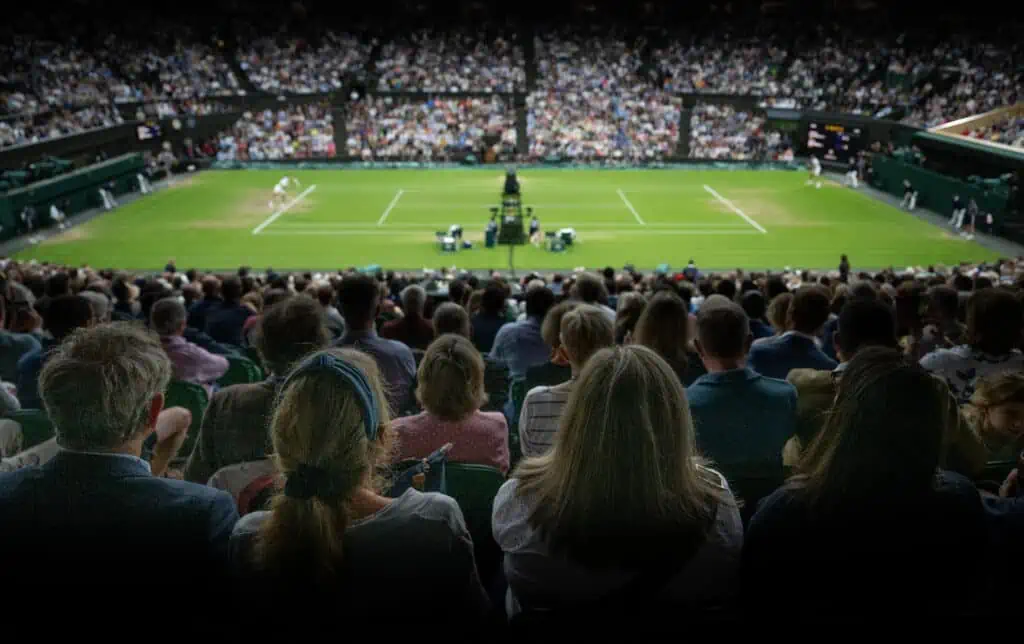
558036 Spectators watch the match between Carlos Alcaraz (ESP) and Daniil Medvedev in the semi-final of the Gentlemen's Singles on Centre Court at The Championships 2023. Held at The All England Lawn Tennis Club, Wimbledon. Day 12 Friday 14/07/2023. Credit: AELTC/Jonathan Nackstrand

Wimbledon Debentures 2027

The first Championships, 1877

The inaugural Lawn Tennis Championship opened on 9 July 1877 at Worple Road. Entry was advertised in the sporting magazine The Field, and 22 men paid one guinea each to compete. Only one event was held, the Gentlemen’s Singles, and it was open exclusively to amateurs.

Rain, a theme that would recur for the next 130 years, delayed the final by three days. When it was finally played on 19 July, roughly 200 spectators paid a shilling each to watch Spencer Gore, a 27-year-old rackets player and Surrey cricketer, beat William Marshall 6-1, 6-2, 6-4 in about 48 minutes. Gore’s tactic was to rush the net and volley, a style that some observers of the day considered faintly unsporting. He collected a silver challenge cup valued at 25 guineas and became the first name on a list that now includes almost every great of the sport.

A quirk of those early years was the challenge round, introduced in 1878. The defending champion sat out the tournament entirely and played only the winner of the All Comers’ event to decide the title. That advantage lasted until 1922.

Growing the tournament: 1884 to 1913

Women’s tennis arrived at Wimbledon in 1884, when the Ladies’ Singles was staged alongside a new Gentlemen’s Doubles competition. Thirteen women entered, and Maud Watson became the first ladies’ champion. Ladies’ Doubles and Mixed Doubles followed as full championship events in 1913, completing the five main draws still contested today.

The tournament’s reach widened quickly. May Sutton became the first overseas champion in 1905, and by then the club’s title had settled into its familiar form, having been changed to the All England Lawn Tennis and Croquet Club in 1899. What had started as a local amateur competition was, within three decades, an international occasion.

The move to Church Road in 1922

By 1919 the Championships had outgrown Worple Road. Demand for tickets far exceeded what four acres could accommodate, and the club needed a new home.

The funding mechanism it chose has become part of Wimbledon folklore. In 1920 the All England Club issued its first debentures, raising £100,000 from around 2,000 buyers who each committed £50 for a 25-year instrument. That money helped purchase the Church Road site and build a new stadium: Centre Court.

The relocated Championships opened in 1922, with Gerald Patterson and Suzanne Lenglen taking the singles titles. The same year the challenge round was abolished, meaning defending champions had to play through the draw like everyone else. The original Worple Road ground is now part of Wimbledon High School’s playing fields.

Two world wars and a bombed Centre Court

The Championships were not held during the First World War, from 1915 to 1918, nor during the Second, from 1940 to 1945. Those interruptions remain, along with the cancellation of 2020, the only years since 1877 in which no champions were crowned.

Wimbledon did not escape the war unscathed. In October 1940 a bomb struck Centre Court, destroying around 1,200 seats. The tournament returned in 1946 with the damage still visible, and full repairs were not completed until 1949. Television, meanwhile, had already arrived: the BBC broadcast from Wimbledon for the first time in 1937.

The Open era arrives in 1968

For its first 91 years, Wimbledon was strictly amateur. Champions received trophies and prestige but no prize money, while the best players in the world increasingly turned professional and were barred from competing.

That ended in 1968. Tennis went “open”, professionals were admitted to the Grand Slams, and Wimbledon paid prize money for the first time: a total fund of £26,150, with Rod Laver earning £2,000 as men’s champion and Billie Jean King £750 as ladies’ champion. The disparity in those two figures would take another 39 years to resolve.

The Open era transformed the standard of the draw overnight and set Wimbledon on the path to becoming the commercial institution it is today. To put the change in perspective, the 2026 singles champions each received £3.6 million.

The rivalries that built the legend

Much of Wimbledon’s mystique comes from a handful of matches that transcended the sport.

Djokovic’s era. Novak Djokovic won seven titles at SW19 and, at the 2026 Championships, passed Federer’s record for most Wimbledon men’s singles match wins, reaching 108.

Borg v McEnroe, 1980. Björn Borg won his fifth consecutive title, but the match is remembered for a fourth-set tie-break that McEnroe took 18-16 after saving five championship points. Borg still won in five.

Navratilova’s dominance. Martina Navratilova won nine ladies’ singles titles between 1978 and 1990, a record that stands to this day.

The Sampras years. Pete Sampras claimed seven titles in eight years during the 1990s, on grass that was significantly faster than the surface players face now.

Federer v Nadal, 2008. Widely regarded as the greatest match ever played, decided 9-7 in the fifth as darkness fell. Roger Federer would go on to hold the men’s record of eight singles titles.

Isner v Mahut, 2010. John Isner beat Nicolas Mahut 70-68 in the final set of a first-round match that lasted 11 hours and five minutes across three days, and which prompted a long rethink of final-set rules.

Murray ends the wait, 2013. Andy Murray became the first British men’s singles champion since Fred Perry in 1936, ending a 77-year drought. He won again in 2016.

The modern era: equal pay, roofs and technology

The last two decades have brought more change to Wimbledon than any period since the move to Church Road.

Equal prize money, 2007. Wimbledon became the last Grand Slam to pay men and women equally, following the US Open in 1973, the Australian Open in 2001 and the French Open in 2006. Roger Federer and Venus Williams were the first champions to receive identical cheques.

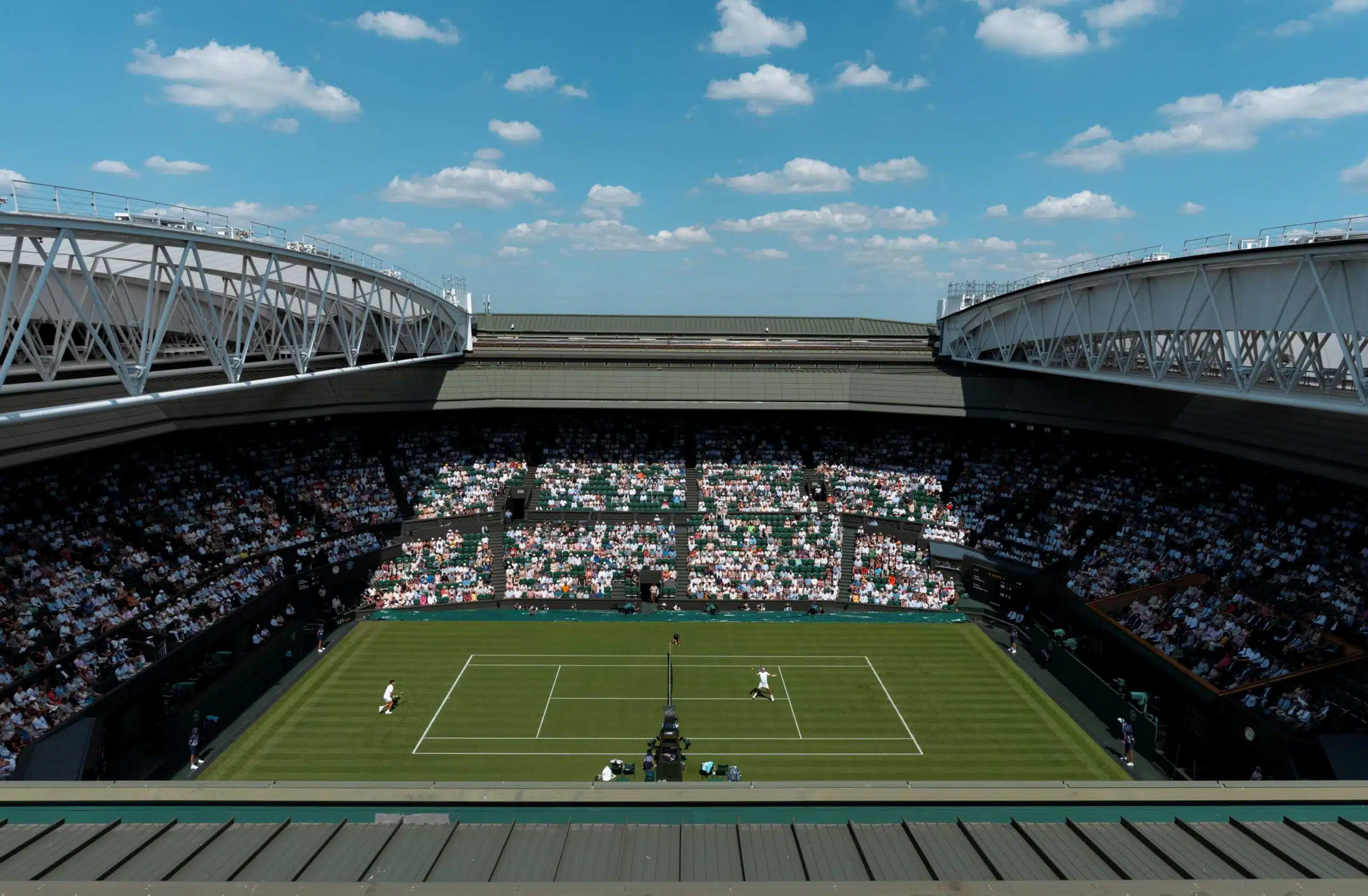
The Centre Court roof, 2009. After more than a century of rain delays, a retractable roof was installed over Centre Court, allowing play to continue in poor weather and finals to finish on schedule.

No.1 Court rebuilt and covered. A new No.1 Court opened in 1997, and a roof was added in 2019, taking the number of covered seats across the two show courts to around 26,500.

The cancellation of 2020. For the first time since the Second World War, the Championships were called off. The All England Club had held pandemic insurance since the early 2000s, a decision that proved unusually prescient and reportedly resulted in a payout of well over £100 million.

Middle Sunday, 2022. The traditional rest day was abolished and the Championships moved to a full 14 days of play.

Electronic line calling, 2025. After 148 years, line judges were removed from every court and replaced by automated electronic line calling. The distinctive uniforms disappeared, and with them the challenge system.

Video review, 2026. Wimbledon became the third Grand Slam, after the US Open and Australian Open, to adopt video review. Players can ask the chair umpire to review judgement calls such as a not-up, a foul shot or a touch, on Centre Court, No.1 Court and four other show courts. Reviews are unlimited, but line calls themselves remain uncontestable. Visual indicators were also added to scoreboards so spectators can see “out” and “fault” calls as they happen.

Wimbledon today and what comes next

The 2026 Championships, held from 29 June to 12 July, offered a snapshot of the tournament’s scale. The prize fund reached a record £64.2 million, a 20 per cent increase on 2025 and the largest single-year rise in Wimbledon’s history, with each singles champion earning £3.6 million and first-round losers guaranteed £80,000.

On court, Jannik Sinner defended his men’s title, beating Alexander Zverev 6-7(7), 7-6(2), 6-3, 6-4 to become the tenth man in the Open era to retain the trophy. Linda Nosková won her first Grand Slam, defeating fellow Czech Karolína Muchová 6-2, 5-7, 6-3 in an all-Czech final. British wildcard Arthur Fery reached the semi-finals, and Novak Djokovic set his new match-wins record. Full detail is in our Wimbledon 2026 review.

The bigger story, though, is off court. The All England Club has proposed a roughly £200 million expansion into the former Wimbledon Park Golf Club, which it bought in 2018. The plans would add 39 courts, including an 8,000-seat show court, allowing qualifying to be staged on site rather than at Roehampton, and would almost treble the size of the grounds.

Planning permission was granted by the Greater London Authority in September 2024 and upheld by the High Court in July 2025. Campaign group Save Wimbledon Park was subsequently granted permission to take that decision to the Court of Appeal, and a separate High Court ruling in March 2026, which found the land was not subject to a statutory public recreation trust, has also been cleared for appeal. Both challenges were still outstanding at the time of writing. If the project ultimately proceeds, the club expects the development to be ready in the early 2030s.

Frequently asked questions

When did Wimbledon start? The first Wimbledon Championships began on 9 July 1877 at the All England Croquet and Lawn Tennis Club on Worple Road. Only the Gentlemen’s Singles was contested, with 22 entrants, and Spencer Gore won the title.

Why is Wimbledon called Wimbledon? The tournament takes its name from the south-west London district where the All England Club was founded in 1868 and where it has been based ever since, moving from Worple Road to Church Road in 1922.

Who has won the most Wimbledon titles? Roger Federer holds the men’s singles record with eight titles. Martina Navratilova holds the women’s singles record with nine.

Why is Wimbledon played on grass? Grass was the original surface of lawn tennis, and Wimbledon is the only Grand Slam that still uses it. The Australian Open and US Open both moved to hard courts, and the French Open is played on clay.

Why do Wimbledon players wear white? The all-white dress code originates in Victorian etiquette, when visible sweat marks were considered unacceptable. The rule has been retained as a defining tradition, with a minor relaxation from 2023 allowing women to wear dark undershorts.

Has Wimbledon ever been cancelled? Yes, on three occasions. The Championships were not held during the First World War from 1915 to 1918, during the Second World War from 1940 to 1945, or in 2020 because of the COVID-19 pandemic.

When was the Centre Court roof built? The retractable roof over Centre Court was completed and first used in 2009. No.1 Court received its own roof in 2019.

When is Wimbledon 2027? The Championships, Wimbledon 2027 take place from Monday 28 June to Sunday 11 July 2027.

Wimbledon debentures with Engage

Debentures are not a modern add-on to Wimbledon. They are part of how the tournament was built. The 1920 issue funded the purchase of the Church Road site and the construction of Centre Court, and every subsequent series has helped pay for improvements to the Grounds, including the roofs that now cover the two show courts.

The structure has remained recognisable for more than a century. A debenture is a five-year financial instrument issued by the All England Club that entitles the holder to one premium seat for every day of the Championships across that term, together with access to the exclusive debenture restaurants, bars and lounges. Scarcity is built in: there are 2,520 Centre Court debentures and 1,250 for No.1 Court. Crucially, debenture tickets are the only Wimbledon tickets that can legally be transferred or resold, which is why they reach the market at all.

That is where Engage comes in. We buy debenture tickets from registered holders and make individual days available to private and corporate clients, so you do not need to own a debenture to sit in one of these seats. Since 2020 we have sold more than 1,500 debentures across the Championships, with over 25 per cent of those customers travelling from the United States and elsewhere overseas.

For The Championships, Wimbledon 2027, running from 28 June to 11 July, we can offer:

  • Centre Court seating between rows A-N, on the same level as the Royal Box, for every round from the first round through to the Men’s Final
  • No.1 Court seating between rows A-Q for rounds one to four and the quarter-finals
  • Access to the premium debenture lounges, bars and restaurants throughout your day, with no fixed dining schedule
  • A dedicated concierge service and support in choosing the right day and court for your group

Availability is finite and moves quickly, particularly for the second week. If you would like to discuss which day suits your guests, enquire about Wimbledon 2027 debentures or contact the team directly.

The oldest tournament, still setting the standard

Very little about the Championships was inevitable. A croquet club that nearly folded, a tournament staged to buy a roller, a debenture issue that paid for a stadium, and a century and a half of decisions about what to keep and what to change. The result is a fortnight that manages to feel both entirely modern and entirely unchanged, where automated line calling and video review sit alongside white clothing, strawberries and a queue in the park.

That balance is the reason Wimbledon still matters, and the reason a seat on Centre Court remains one of the hardest tickets in sport to find.

Wimbledon Debentures  

The Championships, Wimbledon is one of the most prestigious tennis tournaments in the world and fans from all over the globe flock to witness some of the best grass court action around. Played over two weeks in the middle of the British summer, the tournament sees the All England Lawn Tennis Club (AELTC) become the place to be. At the heart of this extraordinary event are Wimbledon debentures, offering the finest seats in the house. 

In this article, we explore what debentures are, the attraction of them and why securing them early is a must. We also glance on the present Wimbledon, speculating on the contenders who may grace the iconic grass courts in the pursuit of tennis history.   

What are Wimbledon debentures? 

Wimbledon Debentures are premium, long-term tickets that provide holders with some of the best seats at The Championships, Wimbledon, and it can be extremely hard to get your hands on them. The money raised from the issues of debentures funds enhancements around the Grounds, for the benefit of all the Wimbledon guests, issued by the AELTC. 

A debenture gives the holder a guaranteed seat for the Championship for five years in prime positions on either Centre Court or No.1 Court. Holders also have access to exclusive areas and facilities of Wimbledon that are not available to regular ticket holders, such as, lounges, car parks, bars, restaurants and more.    

With debenture tickets in extremely high demand and the experience at Wimbledon truly unique, you do not want to miss out. Engage will once again be offering debenture tickets for the 2027 edition of the competition and how the tournament is currently looking in 2026, The Wimbledon Championships will be another fantastic fortnight in the heart of the British summer.  

558036 Spectators watch the match between Carlos Alcaraz (ESP) and Daniil Medvedev in the semi-final of the Gentlemen's Singles on Centre Court at The Championships 2023. Held at The All England Lawn Tennis Club, Wimbledon. Day 12 Friday 14/07/2023. Credit: AELTC/Jonathan Nackstrand

Wimbledon Debentures 2027

Wimbledon 2026

Wimbledon 2026 saw one champion retain his crown and another crowned for the first time. Jannik Sinner defended his men’s singles title, beating Alexander Zverev 6-7(7), 7-6(2), 6-3, 6-4, taking him to his fifth Grand Slam and making him the 10th man in the Open Era to retain the Wimbledon title. Zverev, in his first Wimbledon final, became the first German man to contest a Wimbledon final since Boris Becker in 1995.

Linda Nosková claimed her first Grand Slam title, beating fellow Czech Karolina Muchová 6-2, 5-7, 6-3 in an all-Czech final. Aged 21, she became the youngest Wimbledon champion since Petra Kvitová in 2011.

There were plenty of other talking points. Novak Djokovic surpassed Roger Federer’s record for Wimbledon men’s singles match wins, reaching 108, and British wildcard Arthur Fery reached the semi-finals. In the women’s draw, defending champion Iga Świątek lost in the third round to Alexandra Eala, while Aryna Sabalenka fell in the fourth round to Naomi Osaka, though she kept hold of the world No. 1 ranking.

What tennis is on in 2027? 

With Wimbledon delivering unforgettable moments once again, the excitement doesn’t stop there. Looking ahead to 2027, there’s a packed calendar of world-class tennis you won’t want to miss. From the intensity of the Australian Open in January to the elegance of The Boodles in June, next year offers something for every kind of tennis fan. Whether you’re after Grand Slam drama or boutique hospitality experiences, 2027 is set to serve it all: 

Wimbledon 2026 Delivers Heat, History and Centre Court Glory

The Biggest Storylines From Wimbledon 2026

The lawns of the All England Club have fallen quiet, ending a Wimbledon fortnight shaped by relentless heat, remarkable British progress and two compelling Centre Court finals. Familiar excellence prevailed in the Men’s draw, while the Woman’s’ competition produced a new Grand Slam champion.

Jannik Sinner successfully defended the title he first claimed 12 months ago, while Linda Noskova emerged victorious from an all-Czech final against Karolina Muchova. Here, we revisit the defining stories of Wimbledon 2026, analyse both singles finals and look ahead to the next chapter of the tennis season.

Beyond the Finals: Wimbledon’s Defining Stories

Arthur Fery began the tournament as the world No. 114 and ended it as one of the fortnight’s defining personalities. The British wild card became only the second wild card to reach the Wimbledon men’s singles semi-finals and the first to do so since Goran Ivanisevic 25 years earlier. His remarkable run was finally ended by Alexander Zverev, but not before he had captured the imagination of the home crowd and established himself as one of the tournament’s most popular figures.

The complexion of the men’s draw had already shifted before the first ball was struck. Carlos Alcaraz missed the French Open and the entire grass-court season because of a wrist injury, removing one of Jannik Sinner’s principal rivals from contention. His absence placed even greater attention on Sinner’s title defence, Zverev’s pursuit of a first Wimbledon crown and Novak Djokovic’s latest attempt to add to his extraordinary Grand Slam record.

Djokovic once again demonstrated his resilience in a historic quarter-final against Felix Auger-Aliassime. Their contest became the longest Wimbledon quarter-final ever played, with the 39-year-old finding the physical and mental strength required to reach an eighth consecutive semi-final at the All England Club and the 55th Grand Slam semi-final of his career. Sinner ultimately ended his campaign in the final four, but Djokovic’s marathon victory provided another memorable chapter in his remarkable Wimbledon story.

The ladies’ competition delivered its own major surprises. Naomi Osaka produced one of the results of the fortnight by defeating world No. 1 Aryna Sabalenka in the fourth round. Her aggressive serving and fearless baseline tennis offered a powerful reminder of her ability to control the biggest matches, while Sabalenka’s early departure opened up further possibilities across the draw.

That unpredictability eventually led to an all-Czech final between former Olympic doubles partners Linda Noskova and Karolina Muchova. Their meeting guaranteed another Czech name on the Wimbledon roll of honour, with Noskova’s victory making her the third Czech women’s champion in four years.

All of this unfolded beneath unusually punishing conditions. Instead of the rain delays traditionally associated with Wimbledon, players faced six consecutive days with temperatures above 30°C. The heat tested fitness, recovery and concentration throughout the tournament, adding another layer of tension to an already unpredictable and unforgettable fortnight.

558036 Spectators watch the match between Carlos Alcaraz (ESP) and Daniil Medvedev in the semi-final of the Gentlemen's Singles on Centre Court at The Championships 2023. Held at The All England Lawn Tennis Club, Wimbledon. Day 12 Friday 14/07/2023. Credit: AELTC/Jonathan Nackstrand

Wimbledon Debentures 2027

Back-to-Back: Sinner Retains His Crown

Men’s Singles Final · Centre Court · Jannik Sinner def. Alexander Zverev 6–7(7), 7–6(2), 6–3, 6–4

Jannik Sinner defended his Wimbledon crown after overcoming Alexander Zverev in a four-set final on Centre Court. The world No. 1 recovered from losing a closely contested opening set to claim his fifth Grand Slam title and strengthen his position at the summit of men’s tennis.

Zverev began superbly, serving with confidence and matching Sinner’s power from the baseline. He edged the first-set tie-break 9–7, ending a run in which he had lost 14 consecutive sets to the Italian and raising hopes of completing a French Open–Wimbledon double.

Sinner refused to be unsettled. He raised his level in the second-set tie-break, controlled the exchanges effectively and began finding greater depth on his returns. A decisive break in the third set shifted the momentum before another in the fourth moved him within sight of victory.

After three hours and 46 minutes, Sinner sealed the championship, becoming only the tenth man in the Open Era to retain the Wimbledon singles title.

Zverev joked, “Jannik, I don’t really like you anymore,” before congratulating Sinner and describing him as the best player in the world.

Sinner had been pushed throughout but ultimately proved why Centre Court remains one of his greatest stages.

Czech Mate: Noskova Rules Centre Court

Ladies’ Singles Final · Centre Court · Linda Noskova def. Karolina Muchova 6–2, 5–7, 6–3

Linda Noskova claimed her first Grand Slam title after defeating fellow Czech Karolina Muchova in a dramatic three-set Wimbledon final. At 21, the No. 9 seed showed power, patience and composure to recover after letting several championship opportunities slip away.

Noskova controlled the opening set with fearless baseline hitting, repeatedly pushing Muchova behind the baseline and denying her the opportunity to use her variety. She took the first set 6–2 before moving within touching distance of the trophy in the second.

Muchova refused to fade. Drawing on her experience, she saved five championship points and produced a remarkable comeback to take the set 7–5, transforming a one-sided contest into a tense Centre Court battle.

Noskova responded impressively in the decider, rediscovering her timing and confidence before securing the decisive break. This time, when another opportunity arrived, she made no mistake.

A tearful Muchova said: “It’s really tough to find any words. Linda, my ex-friend! I’m kidding obviously, kind of! You’re so young and this is your first Grand Slam final, and the way you handled it and played was unbelievable.” Noskova arrived at SW19 as a talented contender but left Centre Court as a deserving Grand Slam champion.

Eyes Turn to the Hard Courts. The US Open 2026 Awaits.

23 August–13 September 2026 · USTA Billie Jean King National Tennis Centre, New York

The lawns of Wimbledon have barely fallen quiet before attention begins to shift across the Atlantic. The 2026 US Open begins with Fan Week and qualifying on 23 August, before the singles main draw gets under way at Flushing Meadows on 30 August. The women’s final will take place on 12 September, followed by the men’s championship match on 13 September.

After a Wimbledon fortnight that crowned Linda Noskova as a first-time major champion and saw Jannik Sinner successfully defend his title, the questions heading into New York are plentiful. Can Sinner carry his grass-court form onto the hard courts and reclaim the trophy he lost to Carlos Alcaraz in 2025? Will defending champion Alcaraz be fit and ready to renew one of tennis’s defining rivalries? In the women’s draw, can Noskova maintain her momentum, or will Aryna Sabalenka complete a remarkable third consecutive US Open triumph?

One thing is certain: with the intensity of Arthur Ashe Stadium, the energy of the New York crowds and the season’s final Grand Slam title at stake, the US Open promises another compelling fortnight of world-class tennis.

US Open Hospitality Package

Take your place at Flushing Meadows and experience the energy of the US Open with premium stadium seats, luxury suites, exclusive clubs and exceptional dining. Whether you are entertaining clients or sharing the occasion with friends, our team will help you enjoy New York’s biggest tennis moments with complete confidence

What’s left on the 2026 tennis Calendar?

US Open – 23 August–13 September 2026

Australian Open – 11–31 January 2027; main draw from 17 January

Wimbledon Championship – 28 June–11 July 2027

Wimbledon 2026: Everything You Need to Know Before the First Ball is Struck

The Biggest Storylines Heading Into Wimbledon 2026

The Championships run from 29 June to 12 July 2026, and this year’s edition feels particularly intriguing. Tennis is firmly in the middle of a generational transition, with established champions still capable of winning the sport’s biggest titles while a younger group of stars continues to raise the standard.

A late twist has reshaped the men’s tournament before a ball has been struck. Two-time champion Carlos Alcaraz has withdrawn through injury, blowing the draw wide open.

The result is a fortnight that feels genuinely difficult to predict.

Can Jannik Sinner Establish a Wimbledon Dynasty?

Defending champion Jannik Sinner arrives at Wimbledon 2026 as the clear favourite, and with Alcaraz absent, that status is firmer than ever.

Winning a first Wimbledon title is one thing. Defending it is another entirely.

The Italian’s powerful baseline game, exceptional movement and increasingly reliable serve make him a natural contender on grass. His ability to absorb pace and redirect the ball allows him to dominate rallies without taking excessive risks. He has dominated the season, though an early exit at the French Open was a reminder that he is not invincible.

The biggest question is whether he can handle the pressure that comes with being the player everyone wants to beat.

Historically, Wimbledon has not always been kind to defending champions. Opponents raise their level, media attention intensifies and expectations increase dramatically.

If Sinner navigates those pressures, there is every reason to believe he can claim a second consecutive title.

What Alcaraz’s Withdrawal Means for the Men’s Draw

The story of the men’s tournament is, unavoidably, an absence.

Carlos Alcaraz has withdrawn from Wimbledon with a wrist injury, the same problem that kept him out of the French Open. The two-time champion, who won the title in 2023 and 2024, is focusing on a return during the North American hard-court swing.

His absence removes one of the sport’s biggest attractions and arguably the only player capable of turning defence into attack in a single shot.

It also hands genuine belief to a chasing pack. French Open champion Alexander Zverev steps up as the second seed, while Novak Djokovic, Taylor Fritz and Ben Shelton all arrive with the tools to go deep. The path to the final has rarely looked more open for the players ranked just behind Sinner.

558036 Spectators watch the match between Carlos Alcaraz (ESP) and Daniil Medvedev in the semi-final of the Gentlemen's Singles on Centre Court at The Championships 2023. Held at The All England Lawn Tennis Club, Wimbledon. Day 12 Friday 14/07/2023. Credit: AELTC/Jonathan Nackstrand

Wimbledon Debentures 2026

Could Novak Djokovic Produce One More Wimbledon Run?

Few players in tennis history have enjoyed a relationship with Wimbledon as successful as Novak Djokovic.

The seven-time champion has built his legacy on Centre Court through his extraordinary movement, mental strength and ability to perform under pressure, even if he has not lifted the trophy since 2022.

Now chasing a record 25th Grand Slam title, Djokovic remains a player nobody wants to face during the second week, and Alcaraz’s absence only improves his chances.

While questions naturally surround his physical condition at 39 and his ability to withstand seven best-of-five-set matches, writing off Djokovic at Wimbledon has rarely proven wise.

The Most Open Women’s Draw in Tennis?

The women’s tournament may once again be one of the most difficult Grand Slam draws to predict.

Several players have legitimate championship ambitions, and the differences between them are often marginal.

Iga Świątek arrives with the confidence of a reigning champion. Aryna Sabalenka possesses arguably the most powerful game in women’s tennis. Elena Rybakina remains one of the most natural grass-court players on tour. Coco Gauff continues to improve, while Mirra Andreeva looks increasingly capable of competing for major titles. Add 2025 finalist Amanda Anisimova to the mix and the field looks deep.

There is a headline story off court too, with Serena Williams returning to the draw as a wildcard, the latest chapter in her high-profile comeback.

Unlike previous eras dominated by one or two players, Wimbledon 2026 could feature half a dozen realistic title contenders.

Wimbledon 2026 Gentlemen’s Singles Preview

Why Sinner Starts as the Man to Beat

Jannik Sinner’s rise has been built on relentless consistency.

His game contains very few weaknesses. He serves well, moves superbly, returns aggressively and remains composed in high-pressure situations.

Grass courts suit his ability to take the ball early and dictate rallies.

Perhaps most importantly, he now has the belief that comes from having already won Wimbledon. Sinner has crossed the psychological barrier between wondering whether you can win the tournament and knowing you can.

Who Could Capitalise on Alcaraz’s Absence

With Alcaraz out, the chasing pack scents opportunity.

Alexander Zverev leads it as the second seed and reigning French Open champion. His serve and baseline control can carry him a long way, though he has never been past the fourth round at SW19 and still has plenty to prove on grass.

Taylor Fritz reached the semi-finals here last year and arrives with grass-court momentum. His serve and aggressive hitting make him a threat on the surface.

Ben Shelton is thriving on grass after winning the Stuttgart title, and the American’s explosive left-handed serve can trouble anybody over a short stretch of points.

Jack Draper and the British Comeback Story

No British player will attract more attention than Jack Draper, but he arrives in very different circumstances from a year ago.

An injury-hit twelve months, first an arm problem and then a persistent knee issue, has seen his ranking slide well outside the top 100 from a career-high of world No. 4. He withdrew from Queen’s and returns at Eastbourne the week before Wimbledon, using it to test his fitness ahead of the main event.

There are reasons for optimism. He is now working with two-time Wimbledon champion Andy Murray, and when fit, his powerful left-handed serve, aggressive forehand and athletic movement give him the tools to compete with the best.

The questions are about match sharpness and whether his body holds up over a gruelling fortnight. If it does, a British crowd will be desperate to get behind him.

Potential Dark Horses

Every Wimbledon produces surprise stories.

Matteo Berrettini, a Wimbledon finalist in 2021, remains a dangerous opponent when fit thanks to his powerful serve and forehand combination.

João Fonseca is the rising name everyone is watching after the young Brazilian stunned Djokovic at the French Open, and his ceiling on grass is intriguing.

Neither may begin among the favourites, but each has the ability to derail a higher-ranked opponent.

Wimbledon 2026 Ladies’ Singles Preview

Why Iga Świątek Is No Longer Seen as a Grass-Court Outsider

For much of her career, Wimbledon represented the one major question mark in Iga Świątek’s game.

That narrative has now changed.

Her movement has improved significantly, her serve has become more effective and she has learned to construct points on grass more efficiently. Winning the title transformed perceptions of what she can achieve on the surface.

Rather than entering as a player trying to prove herself, she now arrives as a champion defending her crown.

Aryna Sabalenka’s Power Could Be Decisive

Few players strike the ball as cleanly or powerfully as Aryna Sabalenka.

On grass, where points are often shorter and first-strike tennis becomes more important, those strengths can be devastating.

If Sabalenka serves consistently and limits unforced errors, she may be the most difficult player in the women’s draw to stop.

Her challenge is maintaining composure across a two-week tournament where momentum can shift quickly.

The Case for Elena Rybakina

Many analysts still regard Elena Rybakina as one of the most naturally gifted grass-court players in the world, and as a former champion she knows exactly what it takes at SW19.

Her smooth serving motion, flat groundstrokes and calm temperament all translate beautifully to Wimbledon.

Unlike some players who need rhythm to perform at their best, Rybakina’s game often adapts immediately to grass conditions.

That makes her a genuine contender every time she arrives.

Mirra Andreeva Could Be Ready for a Breakthrough

Every Grand Slam seems to produce a player who makes the leap from promising prospect to genuine contender.

Mirra Andreeva could be that player in 2026.

Her tactical intelligence, court awareness and competitive maturity have impressed observers throughout her young career.

The question is not whether she can compete with the world’s best. It is whether she is ready to do so consistently over seven matches at a Grand Slam.

If the answer is yes, Wimbledon 2026 could become a defining moment in her career.

Final Thoughts: Why Wimbledon 2026 Could Be One of the Most Memorable Championships Yet

Wimbledon has always occupied a special place in the sporting calendar, but 2026 feels particularly intriguing. Carlos Alcaraz’s withdrawal has reshaped the men’s draw and left Jannik Sinner as the clear man to beat, while Novak Djokovic chases further history and a hungry chasing pack senses its chance. The women’s draw, meanwhile, looks as competitive as ever, with several genuine contenders capable of lifting the Venus Rosewater Dish.

What makes Wimbledon so compelling is its unpredictability. Grass remains the most unique surface in professional tennis, rewarding confidence, attacking play and adaptability. Established champions can be vulnerable, emerging stars can announce themselves on the biggest stage and a single match can completely alter the narrative of the tournament.

Beyond the tennis itself, Wimbledon continues to offer an experience unlike any other sporting event. The traditions, atmosphere and history combine to create a sense of occasion that few venues can match. Whether you are watching from Centre Court, following the action from Henman Hill or tuning in from home, there is something unmistakably special about The Championships.

As the countdown continues, fans can look forward to two weeks of world-class tennis, unforgettable moments and the possibility of sporting history being made once again.

One thing is certain: when the first ball is struck on the famous grass courts of the All England Club, the sporting world will once again be watching.

Paris Delivers Pure Drama on the Clay

The 125th edition of Roland Garros has come to a close, and few tournaments in recent memory have matched it for sheer, relentless drama. From the very first round, the red clay of Paris swallowed up seeds, shredded predictions, and produced stories that will be told for years to come.

Two first-time Grand Slam champions were crowned on Court Philippe-Chatrier, both long overdue their moment at the very top of the sport. Here, we revisit the tournament’s defining moments, break down both singles finals, and look ahead to the next Grand Slam on the calendar: Wimbledon 2026, where the finest hospitality experiences are still available.

The Moments That Defined Paris

Roland Garros 2026 was defined by chaos and courage in equal measure. The seeds tumbled early and often, leaving the draw wide open and compelling narratives on every court. A punishing Paris heat wave, with temperatures exceeding 33°C, added a physical dimension to every match, separating the durable from the vulnerable.

Sinner’s Stunning Departure In the defining upset of the season so far, world No. 1 Jannik Sinner, riding a 30-match winning streak, was eliminated in the second round by Juan Manuel Cerundolo. Leading 6-3, 6-2, 5-1, Sinner was visibly struggling physically. Cerundolo won 18 of the next 20 games to seal a historic win, becoming the first man to eliminate the top seed before the third round since 1998. Sinner later revealed he had woken up feeling ill on match day.

Fonseca Stuns Djokovic Brazilian teen sensation João Fonseca, already the talk of the tournament after recovering from two sets down against Dino Prizmic, then went one better by defeating Novak Djokovic in the third round. It was a match that announced Fonseca’s arrival on the very biggest stage and sent the draw into further disarray.

Kostyuk Dances Past Swiatek Marta Kostyuk arrived in Paris on a remarkable 17-match winning streak, and the Ukrainian served notice of her intent by defeating world No. 2 Iga Swiatek in the fourth round. Her joyful, animated celebration, dancing after the opening set, captured the free-spirited brilliance that had characterised her entire clay season.

Kouame’s Carnival on Lenglen One of the tournament’s most heartfelt scenes came on Court Suzanne-Lenglen, where 17-year-old French wildcard Moïse Kouame defeated world No. 71 Adolfo Daniel Vallejo to scenes of pure delirium. The crowd’s chants of “Merci, Moïse!” will long echo around the tournament’s storied history.

Osaka’s Finest Clay Display Naomi Osaka, a player whose relationship with clay has always been complicated, produced what many observers called her finest ever performance on the surface, dismantling young American prospect Iva Jovic in a box-office display that lit up the main court and had crowds on their feet.

A Record-Breaking Upset Wave Never has the Roland Garros draw been this ruthless in the opening week. By the time the second round concluded, No. 7 Fritz, No. 6 Medvedev, No. 9 Bublik, No. 2 Rybakina, and No. 5 Pegula had all been eliminated; an extraordinary cull that left the path to the final open for players who might never have imagined such an opportunity.

Andreeva Claims the Suzanne-Lenglen Cup

Women’s Singles Final · Court Philippe-Chatrier Mirra Andreeva def. Maja Chwalińska 6–3, 6–2 (1hr 22min)

At just 19 years old, Mirra Andreeva became the youngest women’s Grand Slam champion in Paris since Monica Seles lifted the trophy in 1992. It was a performance of remarkable composure and authority from the No. 8 seed, who claimed her first major title in just her fourth appearance at the tournament.

Her opponent, Polish qualifier Maja Chwalińska, ranked 114th in the world, had produced one of the great stories of the fortnight, routing seeds left, right and centre on her way to a maiden Grand Slam final. Chwalińska’s tricky, varied game initially caused problems, with the Pole actually taking a 3-2 lead in the opening set. But Andreeva’s composure proved decisive. Once she broke for 4-3, the match shifted irreversibly. A measured, relentless second set followed, and Andreeva fell to her knees as champion on match point.

“It’s very special for me. I’ve been watching Roland Garros on TV since I was very young.” – Mirra Andreeva, 2026 French Open Champion

Coached by former world No. 2 Conchita Martínez, herself the 2000 Roland Garros runner-up, Andreeva has now surpassed her mentor by one step. The manner of her victory, against a qualifier in blustery conditions, suggested this will be the first of many.

558036 Spectators watch the match between Carlos Alcaraz (ESP) and Daniil Medvedev in the semi-final of the Gentlemen's Singles on Centre Court at The Championships 2023. Held at The All England Lawn Tennis Club, Wimbledon. Day 12 Friday 14/07/2023. Credit: AELTC/Jonathan Nackstrand

Wimbledon Debentures 2026

Zverev: Finally, a Grand Slam Champion

Men’s Singles Final · Court Philippe-Chatrier Alexander Zverev def. Flavio Cobolli 6–1, 4–6, 6–4, 6–7(5), 6–1 (3hrs+)

After 13 years of professional tennis and three previous Grand Slam final defeats, Alexander Zverev finally claimed the title that had long seemed to be his destiny and his torment in equal measure. The 29-year-old German defeated Italian wildcard Flavio Cobolli in a rollercoaster five-set final that kept Paris gripped for over three hours.

Zverev arrived on Court Philippe-Chatrier as the highest remaining seed following the chaos of the preceding fortnight, and initially looked on course for a straightforward afternoon as he swept through the opening set 6-1. Cobolli, competing in his first Grand Slam final, had very different ideas. The Italian grew into the match, levelling the score before a dramatic fourth-set tiebreak sent the contest into a deciding set for the second consecutive year at Roland Garros.

The final set was all Zverev. Composure and experience prevailed as Cobolli’s energy reserves finally gave way, and the German sealed the title he had so often come agonisingly close to winning. In doing so, he became the first German man to win a major singles title since Boris Becker at the 1996 Australian Open.

“No matter what happens, I’ll always be a Grand Slam champion. Now, finally, it’s a happy ending.” – Alexander Zverev, 2026 French Open Champion

Eyes Turn to the Grass. Wimbledon 2026 Awaits.

29 June – 12 July 2026 · All England Club, Wimbledon

The clay of Paris has barely dried before the tennis world’s most prestigious fortnight begins. The 139th edition of The Championships gets underway at the All England Club on 29 June 2026, running through to the finals weekend of 11 and 12 July.

After a French Open that produced two first-time champions, the questions heading into SW19 are plentiful. Can Zverev translate his Paris breakthrough to grass? Will defending men’s champion Jannik Sinner, knocked out so dramatically in Paris, arrive at Wimbledon focused and refreshed? And on the women’s side, can the newly-crowned Andreeva maintain her momentum on the surface where she will have everything to prove?

One thing is certain: with the draw now completely open following the upheaval in Paris, Wimbledon 2026 promises to be one of the most competitive in years; and there is no better way to experience it than from a hospitality or debenture seat.

Wimbledon Hospitality Packages Experience The Championships in style with premium hospitality; fine dining, the finest seats, and unrivalled access to the world’s most iconic tennis venue.

Wimbledon Debenture Seats Secure guaranteed seats on Centre Court or No.1 Court for the entire Championships. Debenture seats offer the ultimate Wimbledon experience, held for all 13 days of play.

What tennis is on in 2026? 

The Summer of 2026: Why This Could Be the Greatest Season in a Generation

Tennis in 2026 has already delivered history, drama and more than a few surprises, and we haven’t even reached the grass yet. With Wimbledon just weeks away and the French Open currently unfolding on the clay of Paris, the summer tennis season is building to what promises to be an extraordinary climax at the All England Club. Here is everything you need to know.

A Quick Look Back: Why 2025 Set the Scene

Before we look ahead, it is worth a brief glance at what made last summer so special, because 2025 is the reason expectations for 2026 are so high.

Jannik Sinner won Wimbledon for the first time, defeating two-time defending champion Carlos Alcaraz 4-6, 6-4, 6-4, 6-4 in a final that crackled with the intensity of two players who know each other’s game better than anyone on the planet. Sinner became the first Italian man in the tournament’s 148-year history to lift the trophy at SW19. In the women’s draw, Iga Swiatek produced arguably the most dominant major final performance in decades, defeating Amanda Anisimova 6-0, 6-0 in just 57 minutes, the first time a player had won a Wimbledon women’s final without conceding a single game since 1911. Between them, Sinner and Alcaraz contested three of the four 2025 Grand Slam finals. The stage was set for an even bigger 2026.

Australian Open 2026: Alcaraz Makes History in Melbourne

The 2026 season opened in Melbourne with a moment that will be talked about for decades. Carlos Alcaraz defeated Novak Djokovic 2-6, 6-2, 6-3, 7-5 in the final to win his first Australian Open title, and in doing so became the youngest man in tennis history to complete the career Grand Slam. At just 22 years old, Alcaraz joined an exclusive group of just ten men ever to win all four majors, and only the sixth in the Open Era, following Rod Laver, Andre Agassi, Roger Federer, Rafael Nadal and Djokovic himself.

The victory also ended Djokovic’s extraordinary 10-0 unbeaten record in Australian Open finals, a run that had seemed almost untouchable. Alcaraz, the world number one heading into Melbourne, was ruthless after losing the opening set, winning three consecutive sets to close it out. It was his seventh Grand Slam title and, at that point, arguably his most meaningful.

Rybakina Ends Her Wait for a Second Major

On the women’s side, the Australian Open delivered its own compelling story. Elena Rybakina defeated world number one Aryna Sabalenka 6-4, 4-6, 6-4 in a rematch of the 2023 final, this time reversing the result, to claim her second Grand Slam title. Four years on from her Wimbledon 2022 victory, Rybakina had endured a difficult intervening period, dropping outside the top 10 at points and navigating a suspension of her coach. Her run to the Australian Open title, which included victories over Iga Swiatek in the quarterfinals and Sabalenka in the final, announced emphatically that she is back among the very best.

French Open 2026: Sinner Hunts Clay Glory as Alcaraz Sits Out

As we write this, the 2026 French Open is underway on the clay of Roland Garros, with the men’s final scheduled for 7 June and the women’s for 6 June.

The big story on the men’s side before a ball has been struck in the latter stages is the absence of Carlos Alcaraz, who has withdrawn with a wrist injury sustained at the Barcelona Open. The defending champion, and two-time Roland Garros winner, will not be in Paris, which opens the door for Jannik Sinner to finally claim the one Grand Slam title that eluded him in 2025. Sinner arrives in Paris as the heavy favourite and top seed, and having won the Italian Open in Rome, his form on clay is the best of his career.

Novak Djokovic is in the draw and has been quietly building his way back into form, while the women’s draw is considerably more open, with Sabalenka, Swiatek, Rybakina, Gauff and others all capable of winning. Gauff arrives as the defending champion.

It also marks a poignant chapter for two French legends: both Stan Wawrinka and Gael Monfils are making their final appearances at Roland Garros, with tributes planned for both men following their last matches.

Wimbledon 2026: The Summer’s Main Event

After everything that has happened in Melbourne and Paris, all roads lead to SW19. The Championships, Wimbledon 2026 begin on Monday 29 June and run through to Sunday 12 July, and the draw for this year’s tournament looks as compelling as any in recent memory.

Sinner, fresh from what many expect will be a French Open triumph, arrives on grass as the reigning champion and world number one. Alcaraz, if his wrist recovers in time, will be desperate to reclaim the title he held in 2023 and 2024. The Sinner-Alcaraz rivalry, which has produced some of the most breathtaking tennis of the modern era, could deliver another Centre Court final for the ages.

On the women’s side, Swiatek will be defending her title on a surface she had historically struggled on before her stunning 2025 breakthrough. Rybakina, a former Wimbledon champion and one of the most dangerous grass-court players on the tour, will be among the favourites, as will Sabalenka, who continues to hunt her first Wimbledon crown.

And of course there is the British angle. Jack Draper, Emma Raducanu and a strong contingent of home players will be cheered on by passionate crowds throughout the fortnight. After Cash and Glasspool’s historic doubles triumph last summer, British tennis arrives at Wimbledon 2026 with genuine momentum.

Wimbledon Hospitality and Debenture Seats: The Best Way to Experience It All

With a season this compelling, demand for Wimbledon 2026 tickets is at an all-time high, and if you want to guarantee your place on Centre Court or No.1 Court, debenture seats are the gold standard.

What Are Wimbledon Debenture Seats?

Debenture seats are the only tickets at Wimbledon that are legally transferable, making them the most reliable and prestigious way to secure your place at The Championships. They come with guaranteed premium seating on Centre Court or No.1 Court, plus exclusive access to private debenture lounges, restaurants and bars that are simply unavailable to general ticket holders.

Debenture seats are positioned at Royal Box level, offering some of the finest views available anywhere in the grounds. Whether you are visiting for the first time or returning as a seasoned Wimbledon guest, the debenture experience combines world-class tennis with a level of comfort and service that makes for a genuinely memorable day.

What Is Included with a Wimbledon Debenture Ticket?

Full day access from 10am to end of play, including outside courts from the morning. Reserved premium seating on Centre Court or No.1 Court at Royal Box level. Exclusive access to private debenture lounges, restaurants and bars, including The Renshaw Restaurant and The Courtside Restaurant. Priority entry via Gate 4 on Church Road, separate from general admission queues. Tickets delivered securely via the official Wimbledon app, with the option to transfer digitally if your plans change.

Why Debenture Seats Are the Best Way to Attend Wimbledon

Unlike general admission tickets, available only through the notoriously difficult public ballot or by queuing overnight on the day, debenture seats offer complete certainty. You choose your preferred date, select your court, and your tickets are delivered directly through the official Wimbledon app well in advance of your visit.

For corporate entertaining, client hospitality, or simply treating someone to a once-in-a-lifetime experience, there is no better option in British sport. The debenture areas transform a day at Wimbledon into something genuinely unforgettable, and with Sinner, Alcaraz and Swiatek all poised to be at the peak of their powers this July, Wimbledon 2026 promises to be unmissable.

Don’t leave your seat to chance. Contact us today to check availability for Wimbledon 2026.

Wimbledon Debenture Seats: Frequently Asked Questions

What is the difference between a debenture ticket and a regular Wimbledon ticket?

Debenture tickets are premium, reserved seats on Centre Court or No.1 Court, sold by registered debenture holders. Unlike general tickets, they are guaranteed, legally transferable and include exclusive access to private lounges, restaurants and bars. They are the only Wimbledon tickets permitted to be resold through official channels.

Can I attend all day on a debenture ticket?

Yes. The Wimbledon grounds open at 10am and you have full access throughout the day, including outside courts in the morning through to the end of play in the evening. Debenture restaurants serve from mid-morning through to supper.

Are debenture tickets suitable for corporate hospitality groups?

Absolutely. Debenture seats are among the most prestigious corporate hospitality options in British sport. We can provide large groupings of tickets seated together, up to 20 people, making them ideal for client entertaining, team rewards or special celebrations.

What is the dress code for the debenture areas?

Smart casual. Jackets and ties are not required for men in the debenture restaurants and tailored shorts are acceptable. Torn jeans, running vests and sports shorts are best avoided.

558036 Spectators watch the match between Carlos Alcaraz (ESP) and Daniil Medvedev in the semi-final of the Gentlemen's Singles on Centre Court at The Championships 2023. Held at The All England Lawn Tennis Club, Wimbledon. Day 12 Friday 14/07/2023. Credit: AELTC/Jonathan Nackstrand

Wimbledon Debentures 2026

When is Wimbledon 2026 and should I book now?

The Championships, Wimbledon 2026 runs from Monday 29 June to Sunday 12 July 2026. Demand for debenture tickets is extremely high this year, particularly given the excitement surrounding the Sinner-Alcaraz rivalry and the strength of the women’s draw. We strongly recommend enquiring as early as possible, particularly for quarter-final, semi-final and final dates.

Do Centre Court and No.1 Court have roofs?

Yes, both Centre Court and No.1 Court have retractable roofs, protecting your day from the unpredictable British summer weather. Note that debenture tickets do not include Wimbledon’s standard rain insurance, but the roofs provide practical cover in almost all circumstances.

What tennis is on in 2026? 

Why Choose Engage for Wimbledon Debentures?

Securing Wimbledon Debentures can often feel like navigating a complex and uncertain marketplace. With limited availability, fluctuating demand, and varying levels of reliability across sellers, it’s essential to work with a trusted and experienced provider. At Engage, we pride ourselves on offering a transparent, secure, and seamless route to accessing some of the most sought-after premium experiences in world sport.

Since Covid, we’ve successfully sold over 1,500 debentures across The Championships, building strong relationships with both private clients and corporate partners. Our expertise allows us to guide clients through every stage of the process, ensuring complete confidence when purchasing. Whether you’re looking to entertain key clients, reward your team, or simply enjoy a bucket-list sporting experience, our team is on hand to deliver a tailored solution.

We work with both B2B and B2C clients, offering flexible options across all 14 days of The Championships. Our reach is also truly international, with over 25% of our debenture sales coming from the US and overseas markets. This global demand reflects not only the prestige of Wimbledon, but also the trust clients place in Engage to deliver premium experiences without compromise.

558036 Spectators watch the match between Carlos Alcaraz (ESP) and Daniil Medvedev in the semi-final of the Gentlemen's Singles on Centre Court at The Championships 2023. Held at The All England Lawn Tennis Club, Wimbledon. Day 12 Friday 14/07/2023. Credit: AELTC/Jonathan Nackstrand

Wimbledon Debentures 2026

What are Wimbledon debentures? 

Wimbledon Debentures are among the most exclusive tickets in sport, offering access to some of the finest seats at The Championships, Wimbledon. Highly limited and consistently in demand, they can be notoriously difficult to secure. Issued by the All England Lawn Tennis Club (AELTC), debentures also play a vital role in funding ongoing improvements to the Grounds, enhancing the overall experience for all attendees.

Each debenture guarantees the holder a seat for every day of the tournament over a five-year period, with prime views on either Centre Court or No.1 Court. In addition, guests benefit from access to a range of exclusive facilities not available to standard ticket holders, including private lounges, premium dining options, bars, and dedicated parking.

With demand continuing to outstrip supply and the Wimbledon experience remaining one of the most iconic in global sport, securing debenture tickets is an opportunity not to be missed.

What tennis is on in 2026? 

With Wimbledon delivering unforgettable moments once again, the excitement doesn’t stop there. Looking ahead to 2026, there’s a packed calendar of world-class tennis you won’t want to miss. From the intensity of the Australian Open in January to the elegance of The Boodles in June, next year offers something for every kind of tennis fan. Whether you’re after Grand Slam drama or boutique hospitality experiences, 2026 is set to serve it all: 

Australian Open 2026 recap: Alcaraz completes the set as Melbourne crowns two new champions

The Australian Open has always loved a storyline, but 2026 delivered them in layers: a generational clash on Rod Laver Arena, a champion completing tennis’ most exclusive checklist, and a women’s final that swung on nerve, serving, and one brutal momentum shift. 

By the time the lights went down on Melbourne Park, Carlos Alcaraz had finally claimed the one major missing from his collection, and in doing so became the youngest man to complete a career Grand Slam. On the women’s side, Elena Rybakina held her nerve to beat Aryna Sabalenka in a rematch years in the making, finishing the fortnight as Australia’s newest singles champion.  

Below, the defining moments, and what this tournament sets up for the rest of the 2026 major season. 

Alcaraz completes his career Grand Slam 

Some players build a legacy by specialising. The rarest ones do it by winning everywhere, every surface, every Slam, every kind of pressure. 

In Melbourne, Alcaraz did exactly that, winning his first Australian Open and locking in the last piece of a career Grand Slam set. The Australian Open’s own tournament recap notes the scale of it: he completed the career Grand Slam at 22 and handed a 10-time champion his first final defeat at the event.  The match itself is already being framed as a symbolic handover, not because Djokovic faded, but because Alcaraz’s ceiling looked like it moved again in real time. 

Men’s final: Alcaraz v Djokovic – a four-set statement 

The headline score tells you the shape of the night: Alcaraz came from a set down to win in four.  
But the texture mattered just as much. 

Set 1: Djokovic struck first, taking the opener and setting a tone of control.  

Set 2: Alcaraz flipped the match quickly, levelling with a convincing response.  

Set 3: The pressure shifted permanently, Alcaraz moved ahead and forced Djokovic to chase.  

Set 4: The closing stretch had everything: long rallies, escalating tension, and Alcaraz landing the final blow to seal history.  

The tournament recap underlined what made it even more striking: by winning in four, Alcaraz both completed the career Slam and dealt Djokovic his first Australian Open final loss.  

Women’s final: Sabalenka v Rybakina – ice, fire, and a turning point from 3–0 down 

The women’s final was the kind of match where the margins feel audible. 

Rybakina beat Sabalenka 6–4, 4–6, 6–4 to win her maiden Australian Open title and a second major overall.  

The hinge moment came in the decider: Rybakina trailed 3–0 in the third set, then stormed back by winning five of the next six games to take the championship.  

The Australian Open’s official report framed it as payback for 2023 and highlighted the tools that made the difference, first serve, backhand weight, and composure when the match tightened. And The Guardian’s post-match reaction leaned into the psychology of the swing, noting the sting for Sabalenka after another final where chances appeared, then disappeared. 

558036 Spectators watch the match between Carlos Alcaraz (ESP) and Daniil Medvedev in the semi-final of the Gentlemen's Singles on Centre Court at The Championships 2023. Held at The All England Lawn Tennis Club, Wimbledon. Day 12 Friday 14/07/2023. Credit: AELTC/Jonathan Nackstrand

Wimbledon Debentures 2026

Key moments that defined the tournament 

Australian Open 2026 wasn’t just about the finals. The fortnight was packed with plot. 

1) Two five-set epics in the men’s semis 
The tournament recap notes that the men’s semi-finals were back-to-back five-set matches (the first time that happened since 2017), with Jannik Sinner falling to a resurgent Djokovic and Alexander Zverev pushing Alcaraz in a marathon described as the tournament’s longest-ever Australian Open semi-final.  

2) A new ‘opening week’ spectacle: the AO 1 Point Slam 
If you missed it, it became a genuine talking point: a knockout where every match is one point. The Australian Open recap calls out the “seconds-long tussles” and the scale of fan interest around it.  
The event’s own report captured the chaos perfectly, rock-paper-scissors for serve, nerves hitting even top players, and an amateur winner taking the $1m prize.  

3) Record-setting crowds at Melbourne Park 
The official tournament wrap-up reports a record 1.37 million attendees across the three weeks.  

4) Breakthrough runs and notable farewells 
The Australian Open recap highlights deep runs for Learner Tien, Ben Shelton and Alex de Minaur, plus an emotional goodbye for 40-year-old Stan Wawrinka in what it framed as a farewell appearance. 

Tennis majors still to come in 2026 

The Australian Open always sets the tone, then the season asks different questions, on different surfaces, in different cities. 

Here’s what’s next on the Grand Slam calendar: 

And if you want the wider month-by-month tour picture around those majors, click here for a full 2026 ATP/WTA calendar view

ATP Finals 2025 Review and 2026 Tennis Preview

A Thrilling Close to 2025 in Turin  

On Sunday in Turin, the indoor hard-court showpiece of the men’s tour culminated in a clash befitting the season’s narrative. Jannik Sinner successfully defended his title at the ATP Finals, defeating his great rival and World No.1 Carlos Alcaraz 7–6(4), 7–5

For Sinner, the victory capped a remarkable indoor run, unbeaten throughout the tournament, and extending his flair under the lights in front of a partisan home crowd.  

Yet even as Sinner raised the trophy, the bigger subplot remains the intense rivalry between him and Alcaraz, two players who have dominated virtually every major title this year. The ATP Finals may mark an endpoint, but in truth it feels like the springboard into something even more compelling. 

Putting the 2025 season under the microscope 

Alcaraz & Sinner: a year for the record books 

In 2025, it was a two-horse race for the top prizes in men’s tennis. Alcaraz and Sinner claimed all four Grand Slams between them, and now the ATP Finals to boot. 

Alcaraz, by virtue of his overall consistency and accumulation of key titles, will finish the year as world number one. Meanwhile, Sinner’s headline-making performances, particularly indoors, demonstrate that this is no brief moment, but perhaps the emergence of a sustained era. 

What this means for the rest of the field

With Alcaraz and Sinner raising the bar so high, the question for 2026 becomes: who can realistically challenge? The gap between them and the “next in line” is meaningful and growing. It invites us to look beyond the familiar names and wonder about the emerging challengers. 

The British element 

From a UK-centric perspective, the story remains “can a Brit break through?” One to watch: Jack Draper, who had a breakthrough season and is eyeing major contention. If 2026 brings the opportunity, it’s one we’ll want to be ready for. 

What storylines will dominate in 2026? 

• Can Alcaraz and Sinner continue their dominance? 

The rivalry that defined 2025 is set to be the headline act again next year. Both players look primed to add more major titles, but the key question is whether either can pull ahead and establish clear control at the top of the rankings. 

  • Who will emerge as a genuine challenger? 

Several top-10 players have shown glimpses of being able to trouble the leading duo, but none have done it consistently. 2026 will be a crucial year for contenders like Zverev, Rune and Ruud to turn flashes of form into sustained pressure. 

  • British hopes on the rise 

Jack Draper’s rise into the world’s elite and Emma Raducanu’s return to form add a fresh layer of excitement for British fans. Both will be looking to carry momentum into 2026 and challenge deeper in the biggest tournaments. 

What comes next for tennis? 

Attention is also shifting towards preparations for the 2026 Grand Slams, with the Australian Open fast approaching in January. From a British perspective, Jack Draper’s standout year, highlighted by his Indian Wells victory and rise to World No.4, has added real excitement, while Emma Raducanu’s steady climb back up the rankings hints at a promising resurgence. Could 2026 be the year a Brit makes a serious push for a major title? 

If you want to see how the next chapter unfolds, join us at Engage Hospitality as we showcase every Grand Slam in 2026. From the Australian Open to Wimbledon, experience world-class tennis from the very best seats as we discover who can catch Carlos Alcaraz, and whether Aryna Sabalenka can elevate her Grand Slam success even further. Don’t miss your chance to be part of it. 

Australian Open – Sunday 18th January to Sunday 1st February 

French Open – Sunday 24th May to Sunday 7th June 

Wimbledon – Monday 29th June to Sunday 12th July

US Open – Monday 31st August to Sunday 13th September 

int(174)